What Is a Vinyl Pre-Master?
If you are planning a vinyl release, at some point someone is going to ask you for a vinyl pre-master. This is not the same file you uploaded to your digital distributor. It is a separate deliverable, prepared specifically for the format.
WHAT A VINYL PRE-MASTER ACTUALLY IS
A vinyl pre-master is a set of audio files optimized for lacquer cutting, the physical process by which sound gets inscribed into a disc before pressing. The cutting engineer takes your pre-master, feeds it into a lathe, and cuts grooves into a lacquer. That lacquer becomes the source for all the metal stampers used to press your records.
What you deliver is one continuous WAV file per side. Side A is one file. Side B is one file. All the spacing between tracks, the gaps, the pauses, the breath between songs is already baked into the audio. It cannot be changed after the fact without going back to mastering. You also deliver a PQ sheet for each side, which tells the cutting engineer where each track starts so they can set the band marks in the lacquer correctly.
This is a different deliverable from your streaming master, your CD master, and your Apple Digital Masters file. Each of those has its own requirements. The vinyl pre-master has its own.
WHY IT IS NOT JUST YOUR DIGITAL MASTER
The most common misconception about vinyl pre-masters is that they require a completely different master. The truth is more nuanced: a vinyl pre-master is a derivative optimization of the same master, not a remake from scratch.
Vinyl is about removing inefficiencies. The format has real physical constraints: groove spacing, stylus geometry, running time per side. The pre-master is where those constraints get addressed before the audio reaches the cutting lathe. A good pre-master minimizes the compensations a cutting engineer has to make so they can focus on maximizing what the record sounds like instead of rescuing it from avoidable problems.
What does that mean in practice? A heavily limited digital master may need the limiter pulled back. Vinyl can handle loud records, and skilled cutting engineers work with loud material regularly, but a cleaner dynamic envelope gives the cutting engineer more room to work. If the limiting is extreme, I will have that conversation with the artist or the cutter before proceeding.
On the low end, I generally do not make significant decisions without knowing who is cutting and what the music actually needs. What I care about is that the pre-master does not hand the cutting engineer a problem they did not need. If the low end is genuinely problematic, out of phase, extreme, likely to cause groove crowding, we address it. If it is not, we leave it alone. Skilled cutting engineers have their own tools at the lathe, elliptical EQ, variable pitch control, and level riding during the cut, and they use them well.
One Session, Not One File Reused
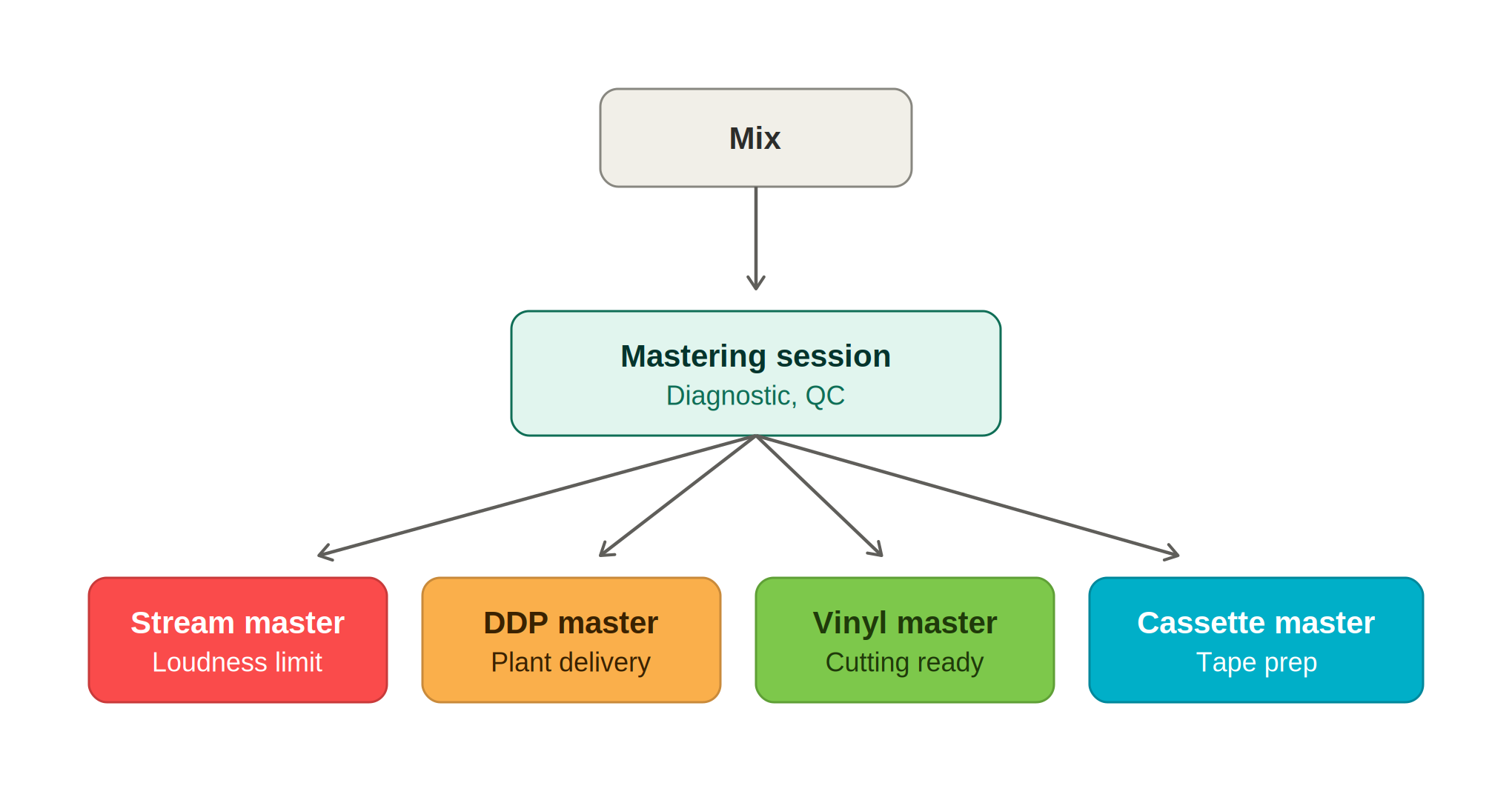
A vinyl pre-master should come from the same mastering session as your streaming master, not from the streaming master itself. One session, one input (the mix), and it branches into whatever formats you need. Same diagnostic pass, same corrective decisions, same room. What differs downstream is the format, not the source.
That distinction disappears when a mix engineer offers mastering as a package deal, then gets asked for vinyl later. What comes back is a vinyl master cut from an already-finished streaming file: limiting baked in, headroom gone, sequencing locked. A cutting engineer can work around that. What they can't do is give you back headroom you never had.
Before you commit to a mix engineer's mastering offer, ask a few questions. Are you getting unmastered mixes or mastered files, and if mastered, do those double as the vinyl masters? Has this person mastered for vinyl before? Are the mixes printed with headroom, or pushed close to 0 dBFS? None of these are accusations. They're the same questions a label would ask.
The Cutting Engineer
A good cutting engineer can apply elliptical EQ, tame sibilance, and adjust level dynamically during the cut. These are real tools and they use them well. But those are compensations, not optimizations. There is a meaningful difference between a cutting engineer who is fixing a pre-master and one who is maximizing it. The goal of a good vinyl pre-master is to put them in the second position.
What a cutting engineer cannot do is change the sequence, adjust the spacing between songs, or alter any decision that is baked into the audio file. Those things are locked the moment the pre-master is assembled. This is one of the most practical reasons to get a proper vinyl pre-master even when the digital master is strong: sequencing, timing, and flow are finalized at my end, not discovered at the plant.
RUNNING TIME AND SIDE SPLITS
Running time per side sets how much groove space each song gets, so longer sides generally mean lower cutting levels and less room for big low end. That makes side splits matter. Which songs go on Side A and which go on Side B, and in what order, affects how the record sounds and how loud it can be cut. It is also a critical artistic decision. The sequence arc of an album was designed to be experienced a certain way, and a side split can either reinforce that arc or work against it. Where Side A ends and Side B begins is a moment the listener feels physically, getting up to flip the record. That transition deserves the same attention as any other sequencing choice. I am happy to weigh in on side splits when the project comes in for vinyl, especially when running times are tight or the sequence needs rethinking for the format.
TELL ME EARLY
The best time to mention a vinyl release is before the digital master is approved, not after. The decisions made at the digital mastering stage, how hard to push the limiter, what headroom is preserved, how the low end sits, all have downstream effects on what the vinyl pre-master can be. When I know vinyl is in the plan, I can archive the session in a way that gives me maximum flexibility for the pre-master later.
If your vinyl release is coming months after the digital, that is fine. I keep detailed archived sessions. You do not need to come back with new mix files. Just let me know and we will work from what is already there.