The Only Manley Mastering Stereo Pultec EQ in the World
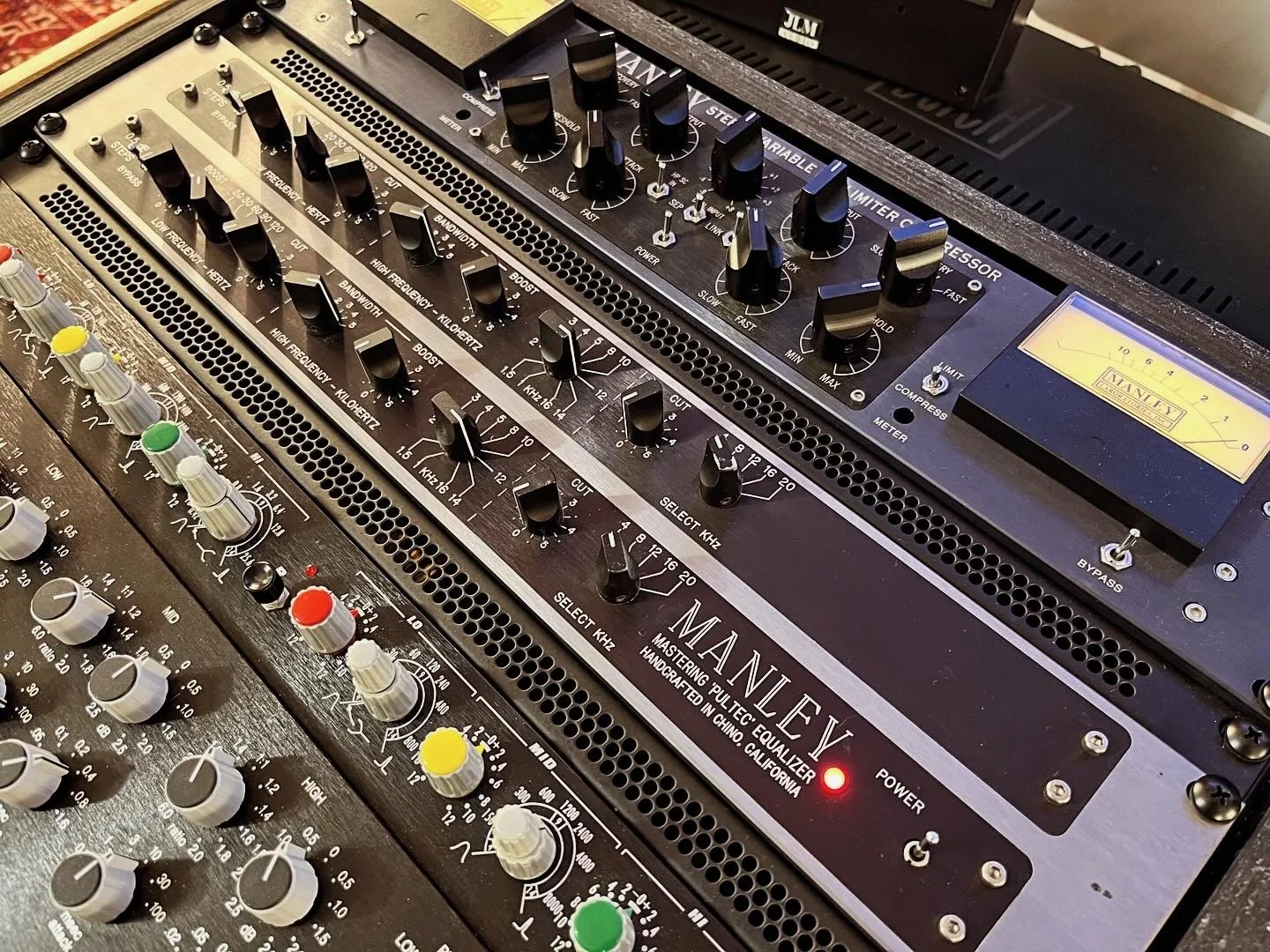
Some gear you go looking for. Some gear finds you. The Manley Mastering Stereo Pultec that's in my rack now falls firmly into the second category. It is, as far as anyone at Manley Labs can confirm, the only one in existence. Thank you Mike Rogers for finding this for me on Gearspace. You have eyes (and ears) like a hawk!
How It Came to Me
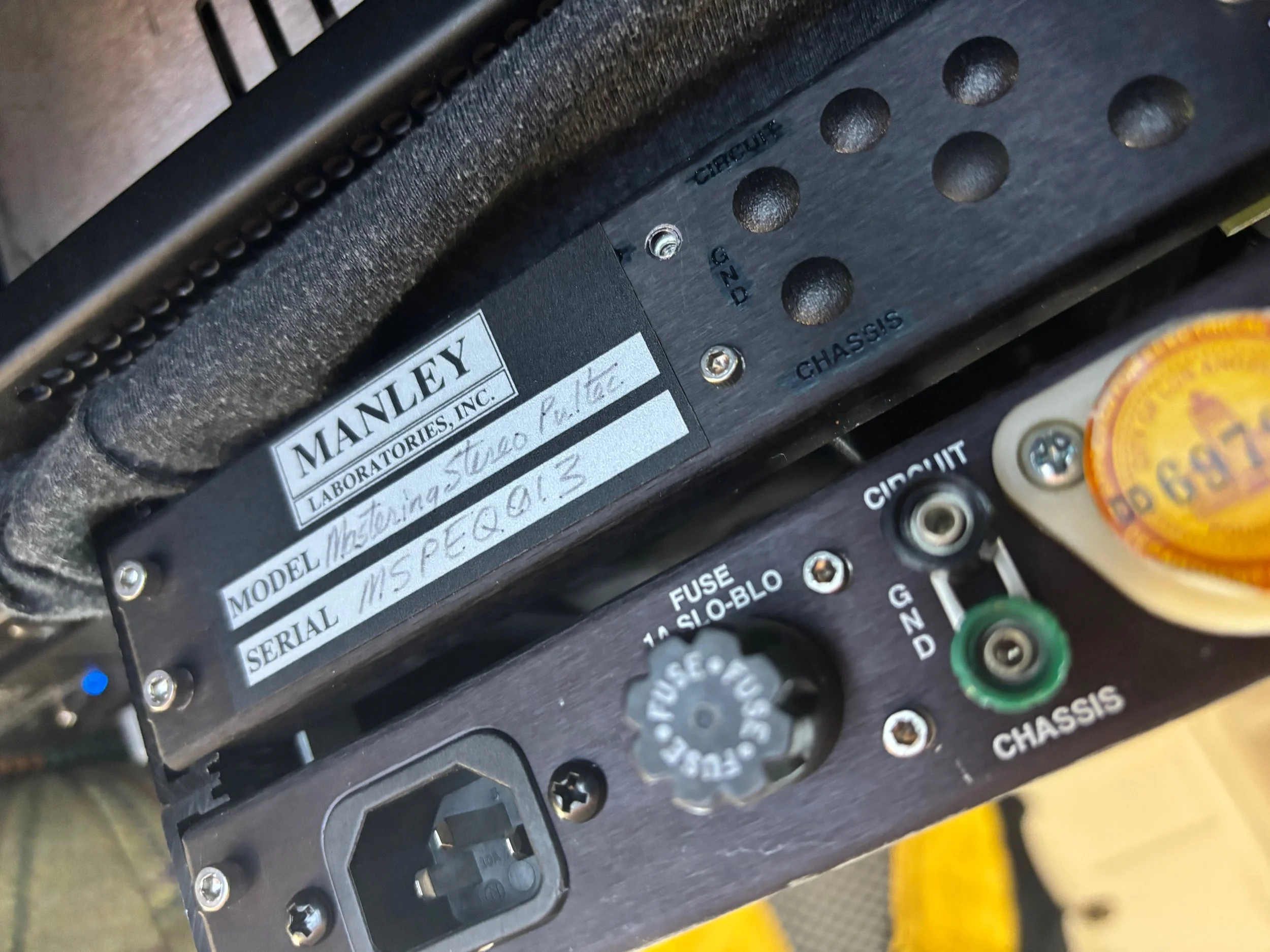
The trail leads back through Kyle McCoy in Edmond, Oklahoma, and before that to a previous owner in Jackson, Mississippi, and before that to Professional Audio Design, the dealer Manley first shipped it to in late 1997. EveAnna Manley confirmed that history, then added something that stopped me cold: as far as she knew, this was the only known example.
Kyle filled in what context he could. The unit was factory built this way. In the late 1990s, Hutch Hutchinson at Manley was doing custom work for mastering clients, and this appears to have come out of that world. The stepped rotary pots were not a feature of convenience, they were a deliberate choice for recall. This was not a catalog product. It was a purpose-built tool, designed for a workflow where you needed to come back to the same setting a week later and trust it.
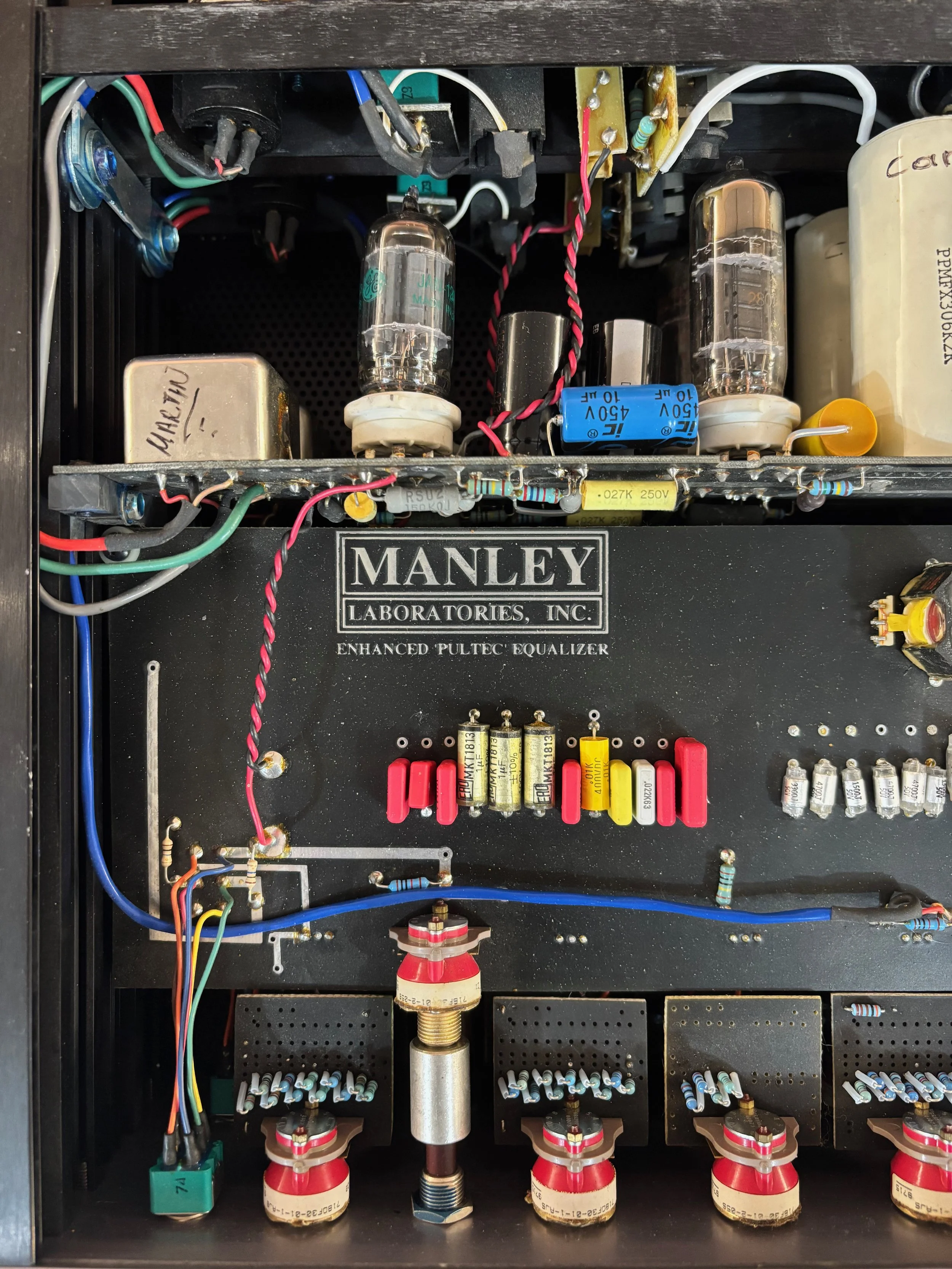
When I opened it up, the circuit confirmed everything Kyle described.
What Manley Built
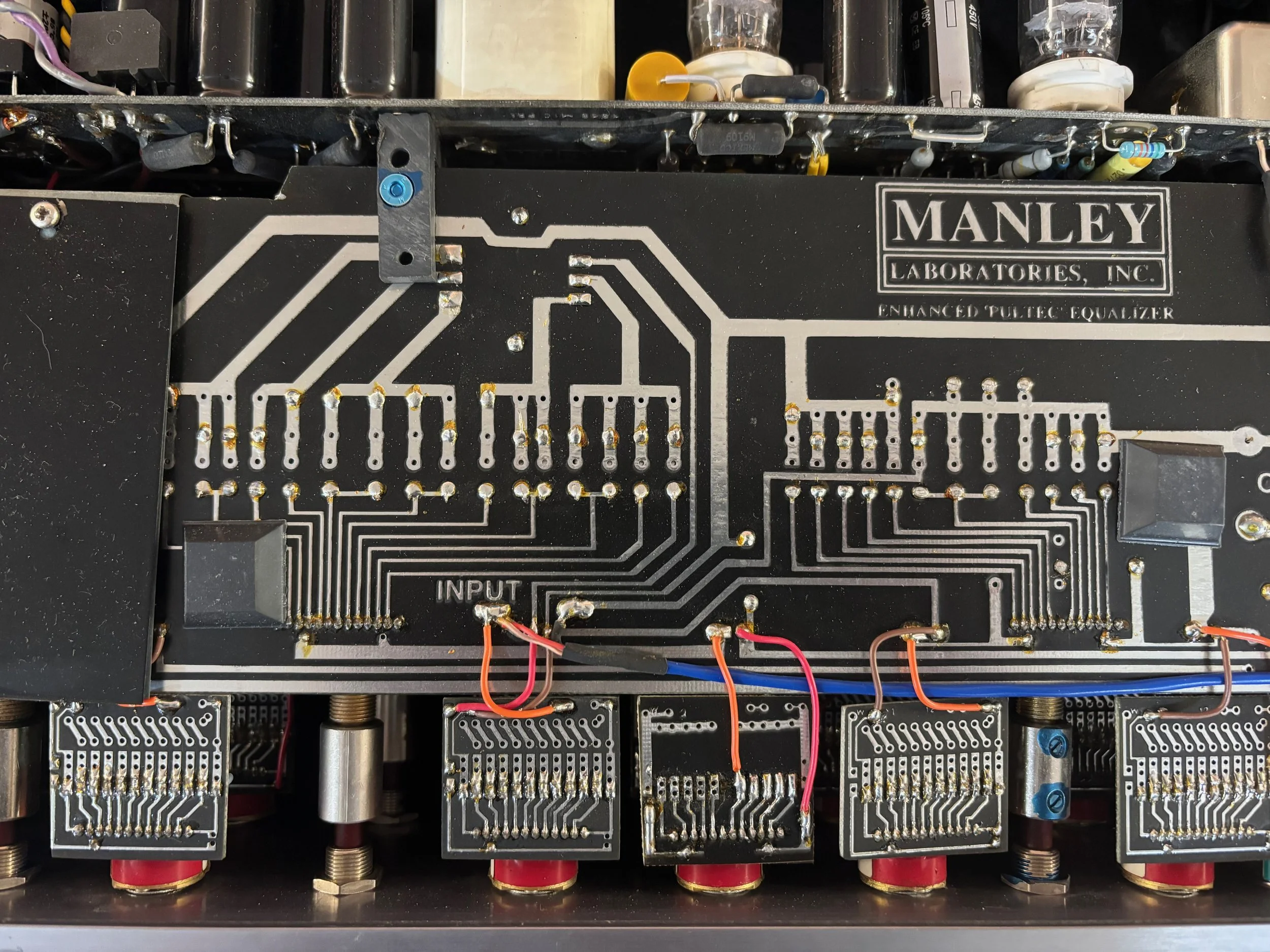
The board is silk-screened "Enhanced 'Pultec' Equalizer" by Manley Laboratories, Inc. That word matters. This isn't a clone or a tribute. Manley was making a claim about the circuit.
The passive EQ circuit itself predates Pultec. It originated at Western Electric, was later licensed to Pulse Techniques, and became the foundation of the original Pultec EQP-1A. Manley tracked down Eugene Shenk, the founder of Pulse Techniques, and asked for his personal blessing to use the design. He gave it and refused any royalties. EveAnna was there.
That moment matters, but not because it granted exclusivity. The circuit topology itself is long out of patent and widely used. What Manley inherited was something less formal and arguably more meaningful: a direct line of continuity back to the source with the personal endorsement of Eugene Shenk himself.
The classic Pultec EQP-1A topology is passive. An inductor-capacitor (LC) network introduces significant insertion loss, recovered by a tube amplifier stage. What Manley changed is the amplifier section, the power supply design, and the component implementation throughout. The passive EQ sections follow the original schematic in form, but they are not built from the same parts or manufacturing approaches as the originals. The fundamental character stays: the simultaneous boost and cut interaction, the way the low shelf blooms, the particular texture of the high-frequency lift. That behavior is baked into the passive network.
Manley has always made a standard mono and stereo Pultec EQ with continuous pots, and a mono Mastering Pultec with stepped controls. This EQ is neither of those. It's a stereo unit built to mastering specs, matched left and right balance, with stepped rotary switches on both channels. As far as EveAnna can confirm, that combination exists on exactly one unit.
On a stereo mastering unit with stepped controls, the whole thing becomes something different. It becomes a mastering tool.
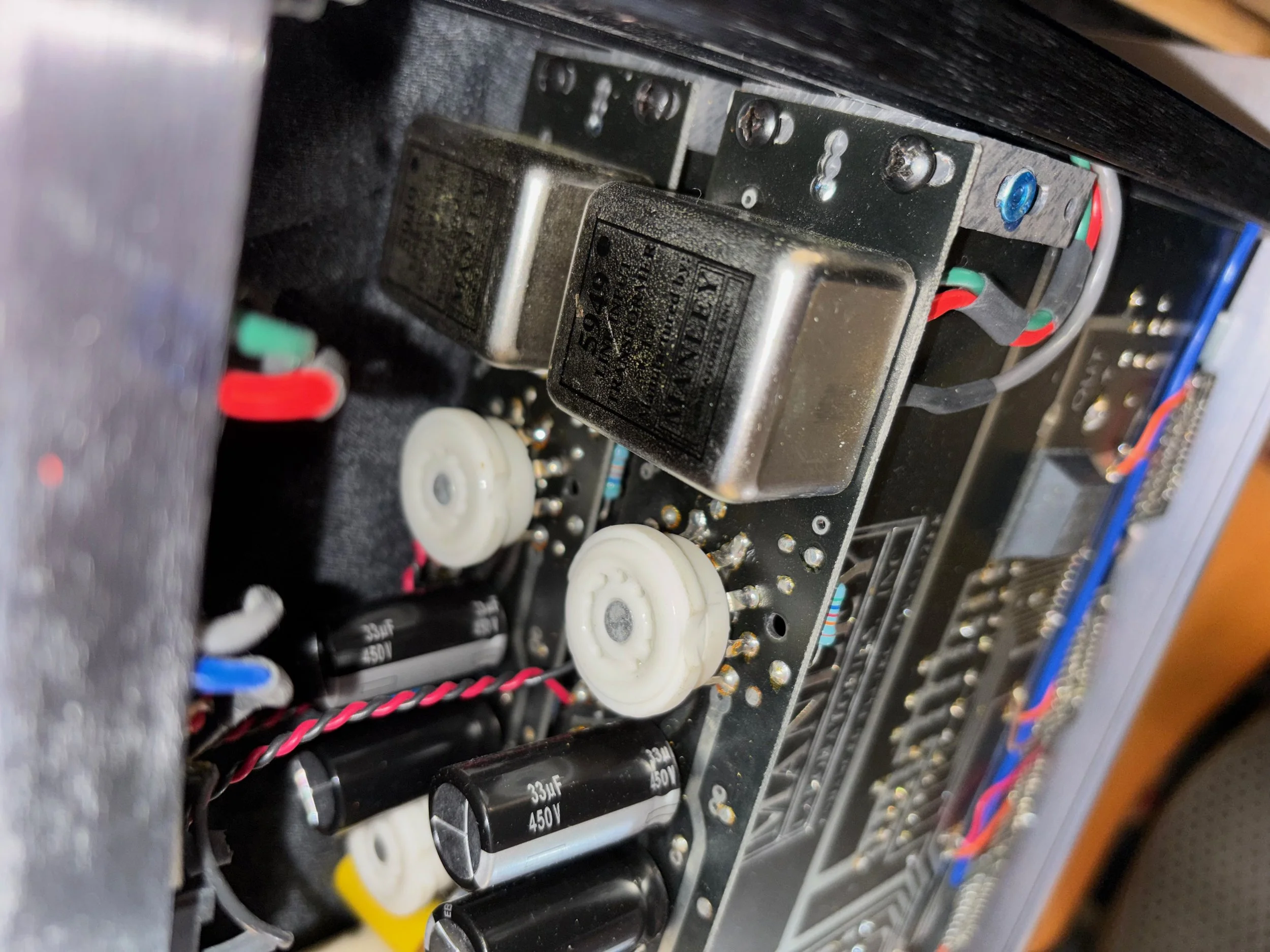
The Transformers
Two transformers sit at the heart of the signal path.
The input is a 5949 Manley line input transformer. The input transformer determines the impedance the source sees, shapes the common mode rejection, and its core material and winding geometry are in the low-end character of everything that follows. On a unit built for mastering, that's not an afterthought.
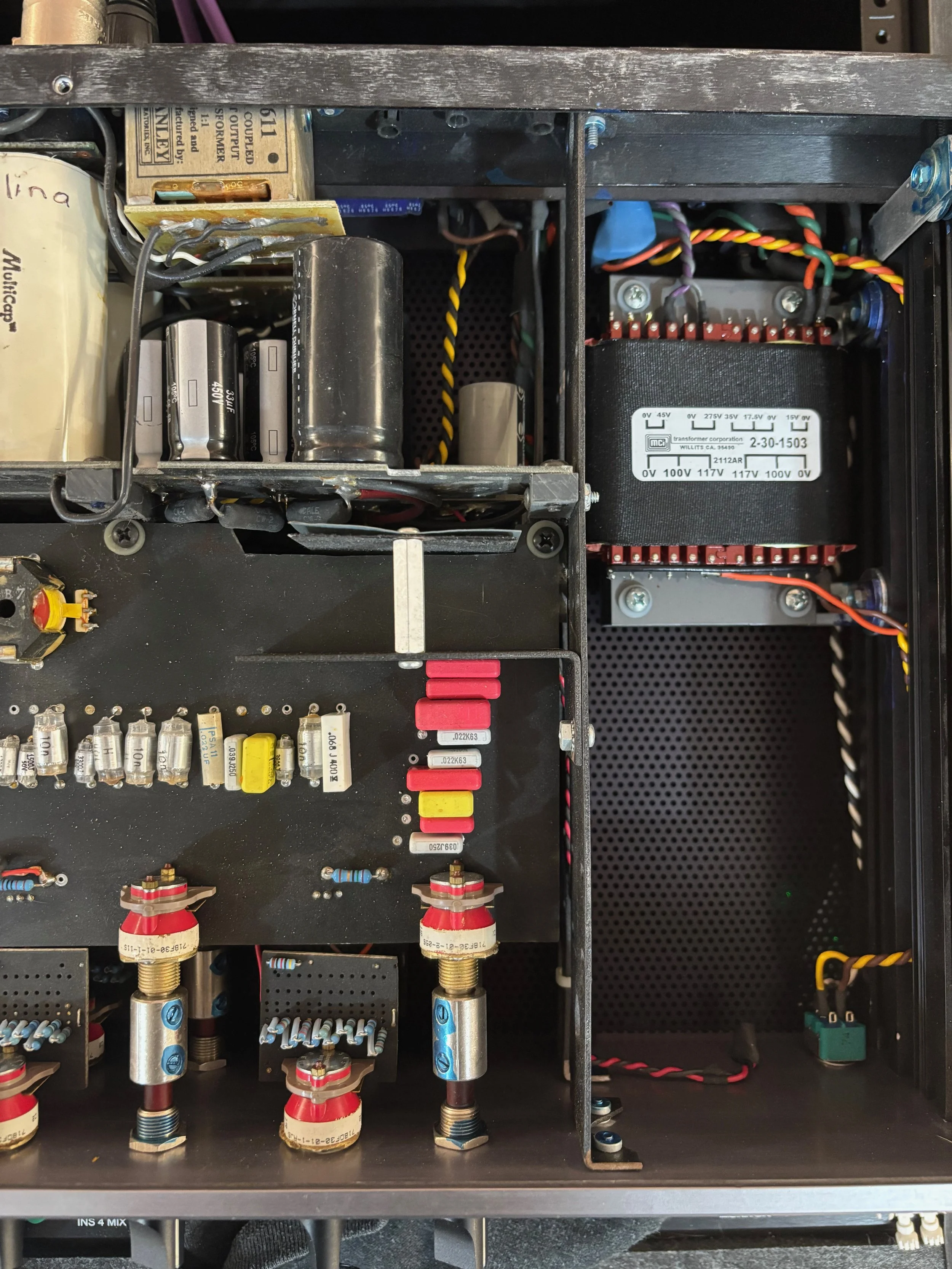
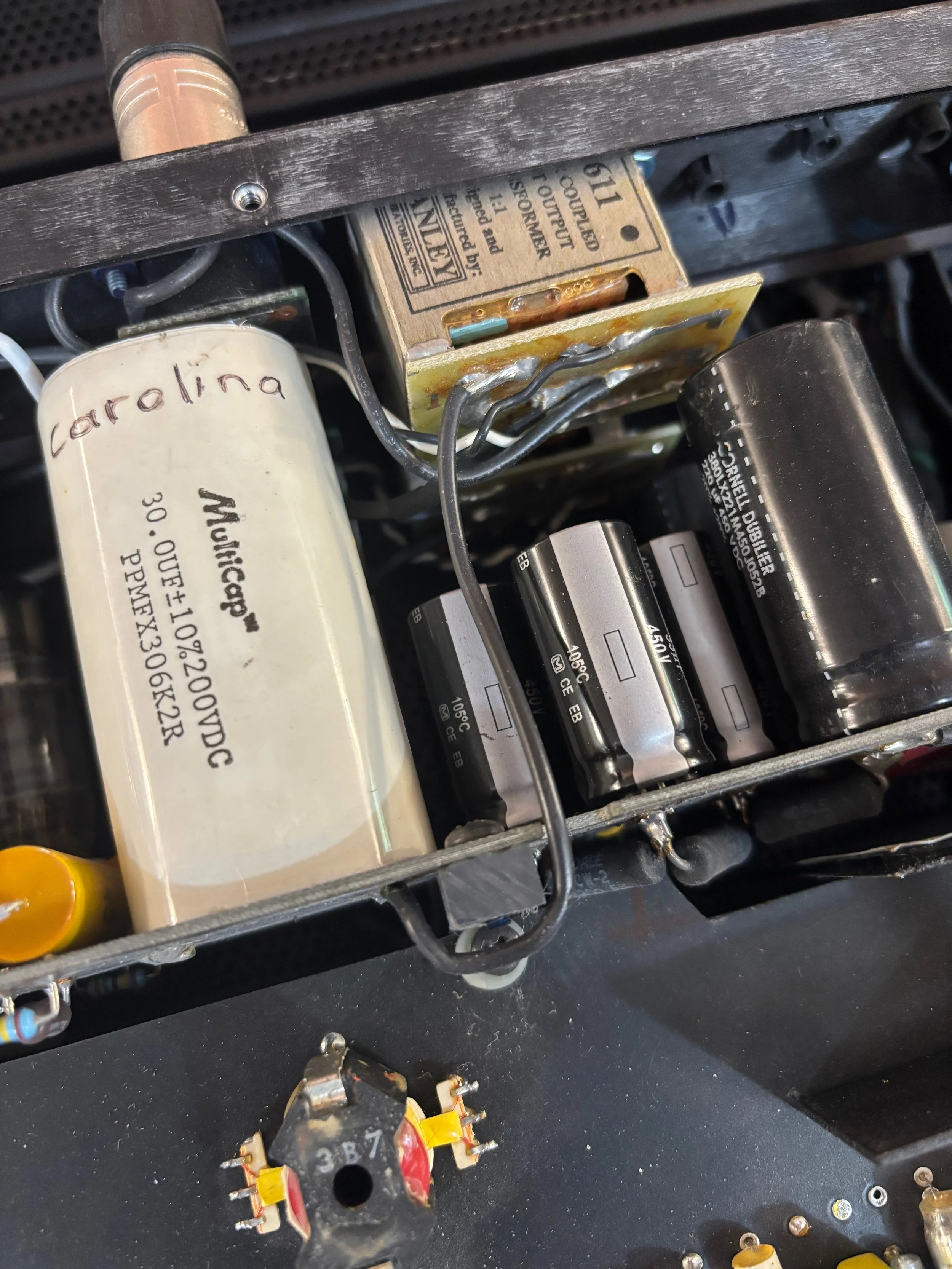
The output is the 9611 Manley Super Coupled Output Transformer. The label on the can reads: "Super Coupled Output Transformer, 1:1, Designed and Manufactured by Manley Laboratories, Inc." The Super Coupled designation refers to a winding geometry that extends bandwidth and improves phase coherence compared to a conventional output transformer. At 1:1, the output stage drives the line with transformer isolation and the character that only well-wound iron provides.
The signal enters through the 5949, passes through the passive LC network, gets amplified, and exits through the 9611. Every EQ decision you make is shaped by those two transformers. That's not incidental. That's the whole thing.
The vintage Pultec has three transformers in the signal path: input, interstage, and output. The interstage transformer sits between the passive network and the tube makeup amplifier. The Manley design removes it entirely. The makeup amplifier stage is direct-coupled to the passive network. Two transformers instead of three, and a fundamentally different amplifier topology as a result.
The Passive Network
The EQ network is populated with components that reflect serious intent.
The stepped rotary switches are Grayhill rotary switches. Each switch position has its own resistor network mounted to a small sub-PCB attached to the switch body. The red and blue color coding on the caps across the switch boards is consistent between both channels. That's how you build a stepped attenuator when stereo matching actually matters.
The signal-path film capacitors are a mix of Evox Rifa MMK series metallized polyester and ERO/Roederstein types. Legitimate parts, well-chosen. The silver mica caps in the network are appropriate for the LC tuning positions.
The frequency positions are different from the vintage Pultec. On the LF side, this unit offers 20, 30, 60, 90, and 120 Hz, the classic Pultec only goes to 100 Hz. The 90 Hz position sits right in the upper bass weight zone, and 120 Hz catches the low midrange bloom. Both are more surgical for mastering than a single 100 Hz point would be.
The HF boost section extends from 1 kHz all the way to 16 kHz, eleven positions total. The vintage EQP-1A starts at 3 kHz. Having 1 kHz and 1.5 kHz boost positions on a Pultec-derived design is genuinely unusual and puts this unit firmly in presence and upper midrange territory that the original never touched. The HF bandwidth control is a 5-position rotary switch rather than a continuous pot, five discrete Q settings from broad to narrow, all repeatable.
The boost and cut range is ±5.5 dB in 0.5 dB steps throughout. The vintage Pultec offers up to +13.5 dB boost and −17.5 dB cut. The narrower range here isn't a limitation, it's a mastering-specific decision. In mastering, 2 dB is a loud statement. 5.5 dB is the ceiling you should rarely reach.
The Amplifier Stage and the Multicap
One component stopped me when I first opened the unit.
Mounted in the power supply section is a Multicap PPFMX306K2R capacitor. 30 µF, ±10%, 200 VDC film/foil polypropylene, for the nerds. Written on it in marker: “Carolina.”
Carolina still works at Manley Labs. She has been there since before this unit shipped. The Multicap PPFMX series is boutique-grade, significantly more expensive and more capable than a standard electrolytic in the same position. Whether this was original to the build or installed during an early service visit, it was a deliberate choice. There's a boutique film capacitor in a one-of-a-kind tube EQ with a Manley employee's name written on it in marker. That's either the most or least professional thing I've ever seen inside a piece of gear. I can't decide.
The rest of the electrolytic complement was a different story. The pre-recap photos show the original power supply rails populated with Jamicon 33uF 450V caps, EveAnna had flagged these before I even had the lid off, and she was right. Jamicon is a budget-tier brand, and at nearly 28 years old those caps needed to go regardless of how the unit sounded. The 10uF 450V feedback cap was a Nichicon, visible as the purple cylindrical unit in the pre-service photos. Also past its reasonable service life.
The Tubes
The four tubes in this unit are among the best reasons to be excited about it.
Left to right: two Raytheon 6414 MIL-spec dual triodes and two JAN-GE 12AU7A MIL-spec tubes. All four passed inspection at 28+ years old.
Two Raytheon 6414s. The 6414 is not a common tube. It's a ruggedized, low-noise dual triode built to military specification, same pinout as a 12AU7, but manufactured to tighter tolerances for noise, gain matching, and operating life. Raytheon made some of the finest examples. The internal frame construction visible through the glass is consistent with 1960s production. These are genuinely rare parts. The 6414 was built to survive battlefield conditions. It ended up doing something far more important.
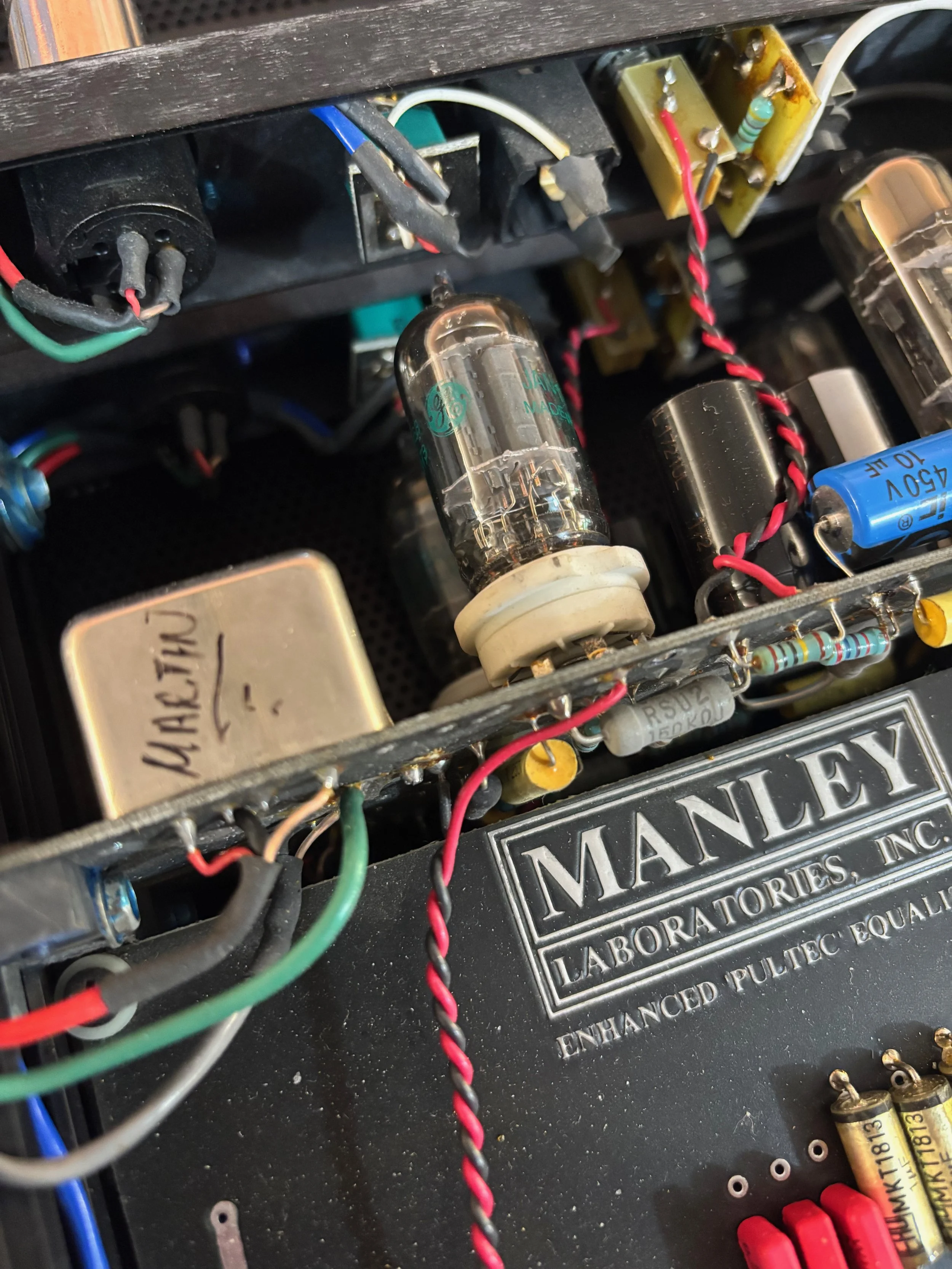
Two JAN-GE 12AU7As. JAN stands for Joint Army-Navy, military procurement spec, built and tested to tighter tolerances than commercial production. The GE logo is visible in teal on both tubes. The internal plate structure is the classic GE long-plate construction, and the halo getter is consistent with late 1950s to very early 1960s production, almost certainly from GE's Owensboro, Kentucky plant. JAN-GE 12AU7As from this period are among the most respected American-made dual triodes.
Matched tubes across two types, in a stereo mastering EQ. Whoever spec’ed this knew exactly what they were doing.
The Power Supply
At some point in the unit's life the original power supply developed a mechanical hum, Len Knitter at Manley described it as originating in the transformer laminations. His senior tech confirmed it wasn't in the audio path, for what it’s worth, but colored my room. Mechanical hum from aging laminations is a known issue with older iron-core designs. Luckily, it doesn't corrupt the signal. The power supply has since been rebuilt.
The power transformer is a Transformer Corporation unit from Willits, California, part number 2-30-1503, with secondary taps including a 275V high-voltage rail for the tube plates. Custom wound.
The Recap at Manley
When the time came to address the aging electrolytic capacitors, I sent the unit back to Manley. Len Knitter did the work. His tech report:
"Replaced ten 33uF 450V electrolytic capacitors. Replaced two 10uF 450V electrolytic capacitors. Cleaned all front panel switches. Cleaned all inputs and outputs. Tubes were inspected and met spec. The output gain was adjusted. The unit received a complete test." Not bad for a unit that’s 28 years old!
Having the factory service a one-of-a-kind factory build is the right call. The people who built it know what was intentional, what should be preserved, and what needed to go. The Jamicons are gone. The Nichicon feedback cap is replaced. The Multicap signed by Carolina is untouched.
Both Carolina and Martin, whose names are written on the capacitor and input transformer respectively, still work at Manley. The people who built it are still there.
The Manley Mastering Stereo Pultec EQ vs. the Vintage Pultec EQP-1A
Same DNA. Different philosophy.
The vintage Pultec EQP-1A is a broad strokes tool. It was designed for tracking and mixing, big moves, wide brushes, enormous range. Up to +13.5 dB of boost, −17.5 dB of cut, a continuous bandwidth pot, and frequency positions that made sense for program EQ in a broadcast or recording context. It's one of the great tools in audio history precisely because of that generosity of range and character.
The Manley Mastering Stereo Pultec EQ starts from the same passive LC topology and the same transformer-in, transformer-out philosophy, then makes a series of deliberate mastering-specific choices at every turn.
The LF boost and cut range is ±5.5 dB in 0.5 dB steps. Not 13.5 dB. In mastering, that's not a constraint, it's a calibration. The frequency positions shift the 100 Hz of the vintage unit into 90 Hz and 120 Hz, bracketing that upper bass and low mid zone with more precision than a single position allows. The 90 Hz position sits right in the weight zone. The 120 Hz position catches the low mid bloom. You get more surgical control in the region that matters most for mastering decisions.
The HF section is where the difference is most significant. The vintage Pultec is fundamentally an air and low end tool, seven boost positions starting at 3 kHz, topping out at 16 kHz. The Manley Mastering Stereo Pultec EQ adds 1 kHz, 1.5 kHz, and 2 kHz to that range, bringing the passive LC boost character down into the presence and upper midrange zones a vintage unit simply cannot touch. That's not a modification or an enhancement, it was spec'd this way for mastering, where shaping the 1-3 kHz region with the musical character of a Pultec topology is genuinely useful.
The bandwidth control is switched rather than continuous, five discrete Q positions versus the vintage's infinite variation. In mastering that's the right tradeoff. Repeatability matters more than infinite variability.
And it's stereo. Two matched channels, independent stepped controls, in a 2U chassis. A matched pair of vintage mono Pultecs gets you the same topology but not the same unit-to-unit consistency with being matched. This was built as a stereo mastering tool from the ground up.