The Maselec MLA-4: Triband Compressor, Expander, and the Easter Egg Leif Kept Off The Manual
Most mastering engineers are suspicious of multiband compression. The reputation is earned. Split a signal into frequency bands, process them independently, and recombine them, and you have introduced new problems into a mix that almost certainly did not have those specific problems before you touched it. Phase artifacts at the crossover points. Gain pumping that bleeds between bands. Tonal imbalance that tightens one region while something weird happens to the one next to it. The list of ways multiband can go wrong is longer than the list of ways it can go right, and most engineers who have used it carelessly have a session in their memory that they would rather not revisit.
That suspicion is one reason the Maselec MLA-4 is still so underexplained after more than a decade on the market. It is categorized as multiband, and so it gets passed over by engineers who have learned to be wary of that category. That is a mistake, and this piece is an attempt to explain why.
The Man Who Built What He Needed
Leif Mases is a Swedish engineer and producer who spent decades working with ABBA, Led Zeppelin, Black Sabbath, and Jeff Beck, among others, and co-owned Marcus Studios in London. He is also qualified in electronic design, which is an unusual combination and the reason Maselec exists at all. When you have both the session experience to know exactly what is wrong with the available tools and the engineering background to do something about it, you build the tools yourself.
The first Maselec product was not a compressor. It was the Maselec 9001, a retrofit EQ for the SSL 4000 console. Then the MEA-2 precision parametric mastering EQ, developed with Prism Sound in the mid-1990s, which I first saw in college at the studios at Middle Tennessee State University. Then the MLA-2 stereo compressor. Each product came from the same direction: here is what mastering actually requires, here is what is available, here is what is missing.
The MLA-3 was the answer to what was missing in multiband compression. Three bands, passive crossovers, stepped controls, mastering-grade specs. It earned a serious reputation in mastering rooms because it did what other multiband compressors could not: compress per band without introducing the phase and summing artifacts that made the category suspect in the first place. It did one thing well, with precision and recall.
What it could not do was expand. And that turns out to matter.
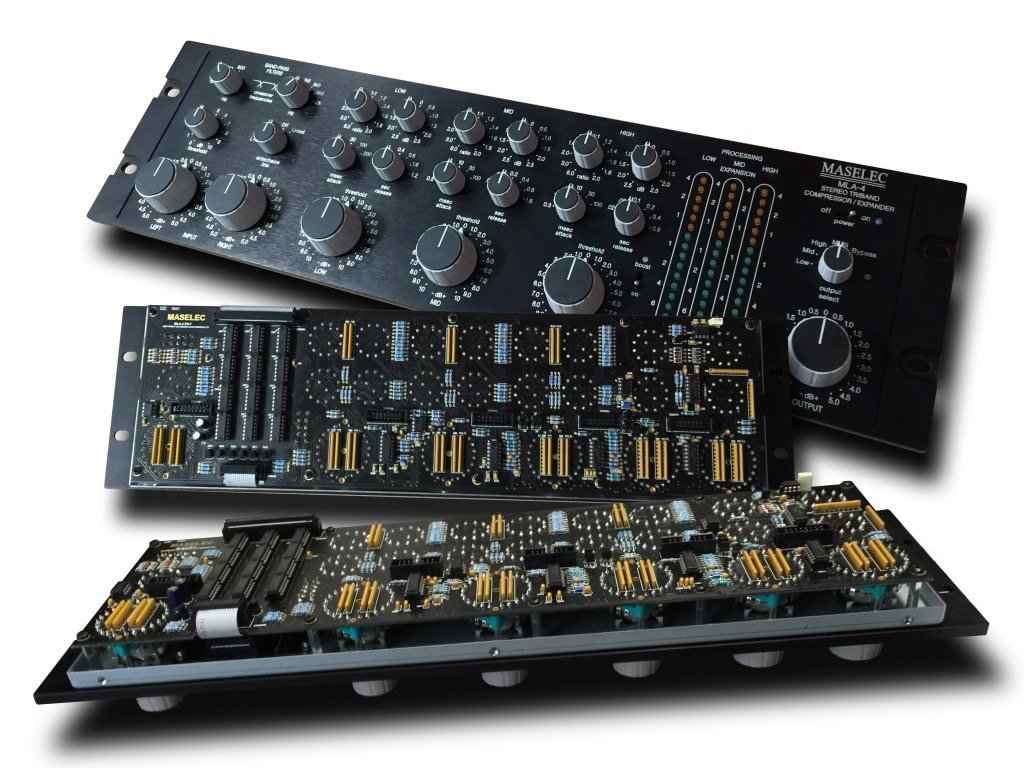
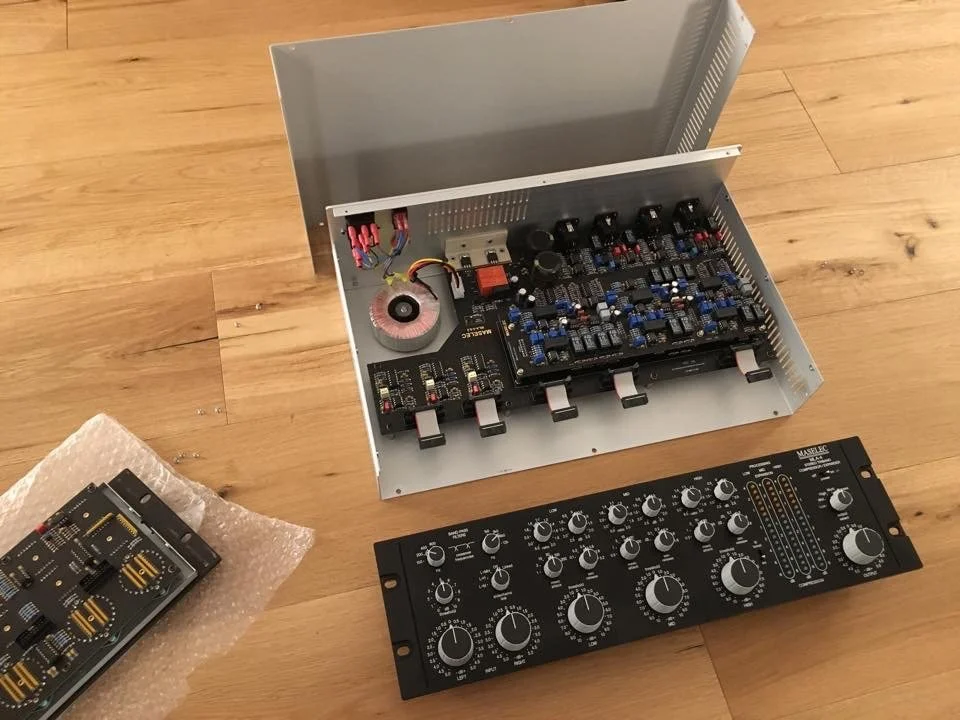
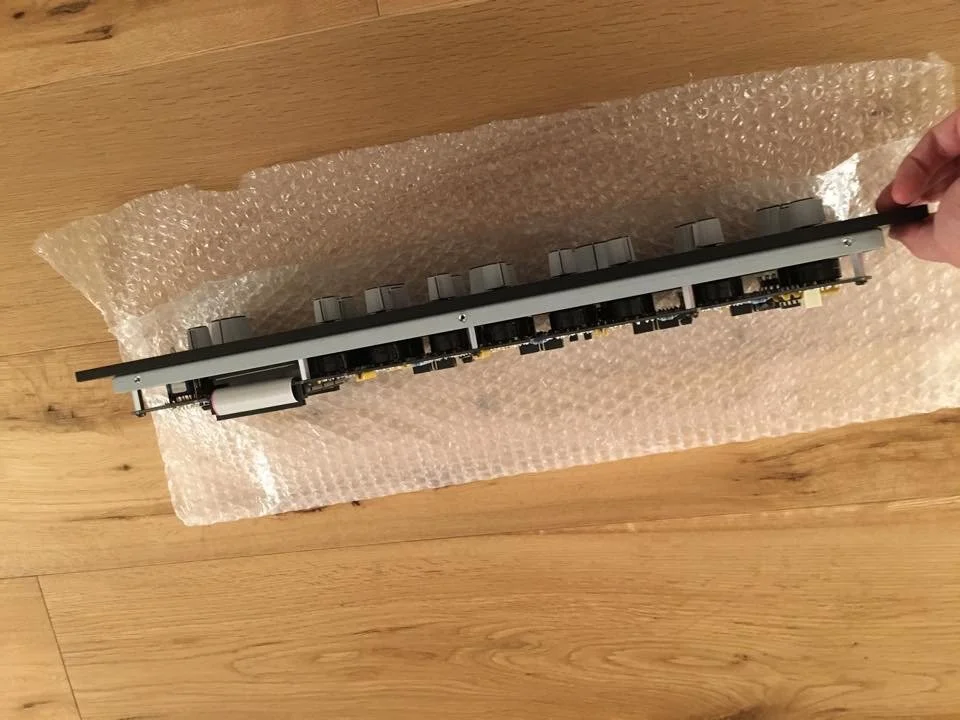
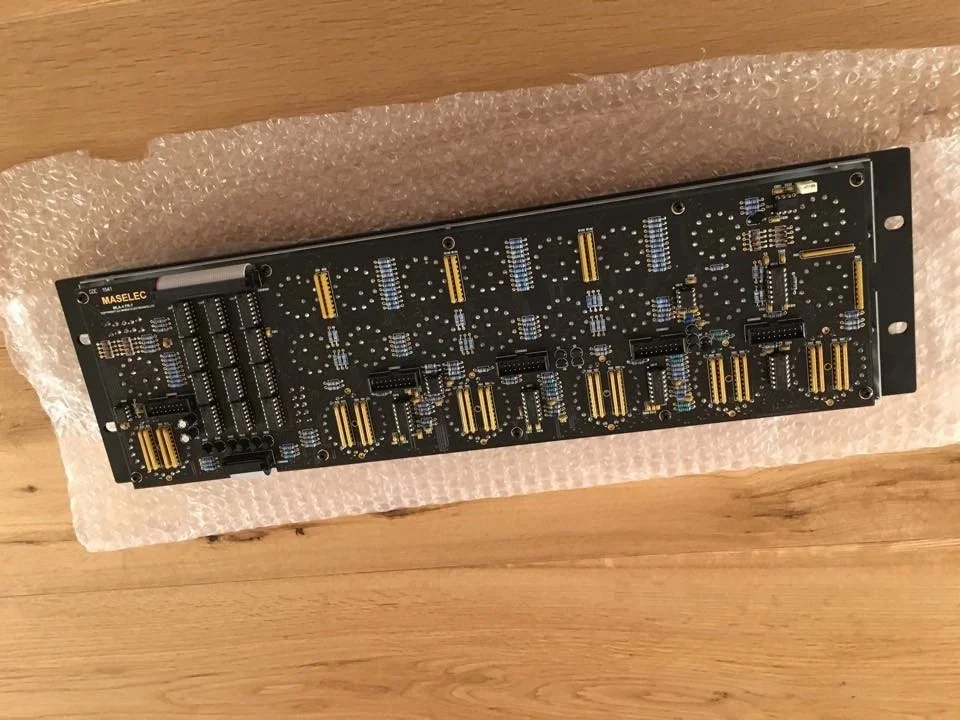
When Leif developed the MLA-4, he did not start from scratch. The core architecture of the MLA-3 stays intact. What the MLA-4 adds is an expander on every band, new sidechain linking capabilities, and the program-dependent timing circuit that is the subject of a later section in this piece. The relationship between the two units is close enough that Maselec offered a retrofit kit in 2010: MLA-3 owners could order the upgrade for $2,000 USD, swap the front panel and the electronics behind it, and have an MLA-4 in 15 to 20 minutes with no soldering required. Plug and play, connect five ribbon cables, done. That is not how most hardware upgrades work. It tells you something about how deliberately the MLA-4 was designed on top of the MLA-3 foundation.
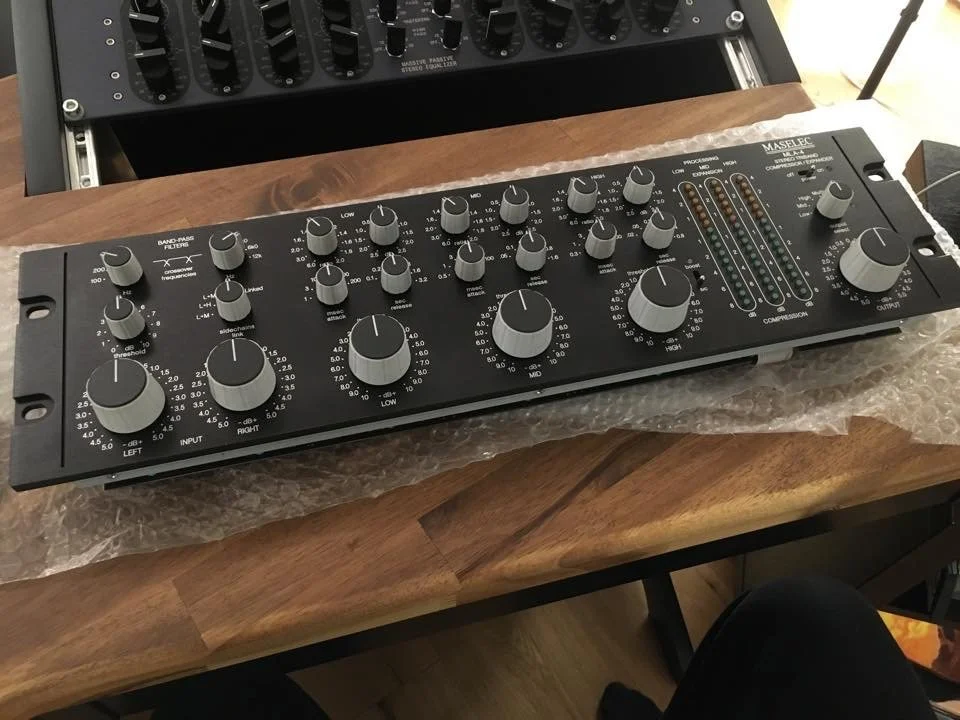
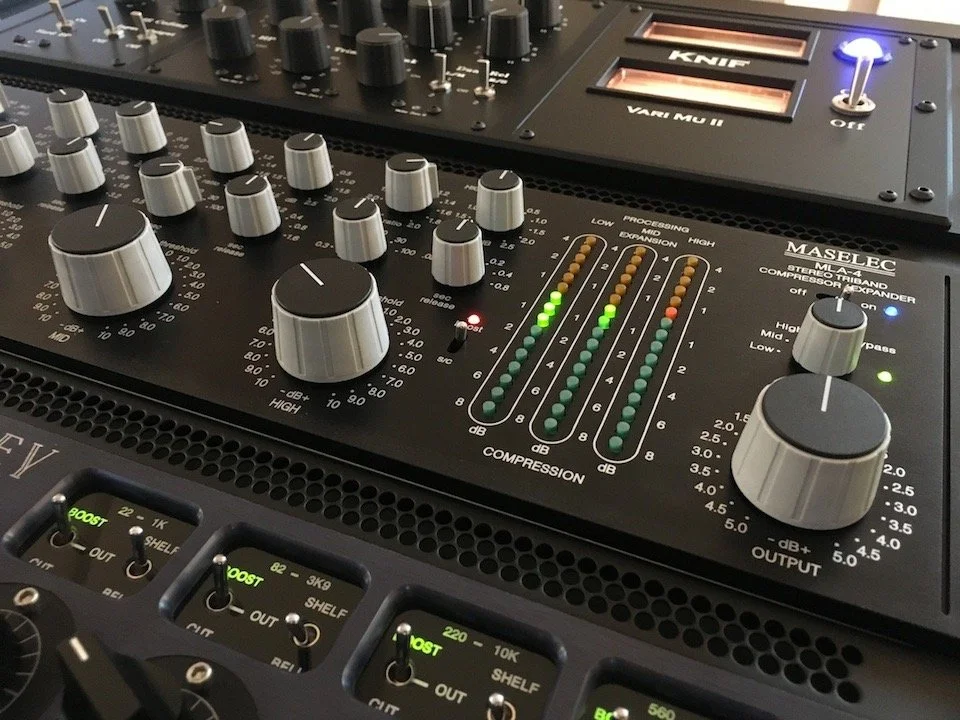
What the MLA-4 Actually Is
The MLA-4 splits the input into three frequency bands, runs each through an independent compressor/expander, and recombines the outputs. The architecture on paper is not novel. The execution is what separates it.
The crossovers are passive, with 6dB/octave slopes. This is worth focusing on. Passive crossovers with this slope sum to an absolutely flat frequency response across the full band. The three outputs, when recombined, add back to exactly what went in. There are no phase artifacts at the crossover points, no gain anomalies, no notches or bumps at the transitions. The manual states this plainly and then moves on without comment, but it is the foundation of everything else the unit does. It is why the MLA-4 does not do what multiband compressors usually do to a mix. The signal splits cleanly and rejoins cleanly. What happens in between is up to you.
The inputs are electronically balanced and described in the manual as "virtually ground floating, making them perform as if they are transformer coupled, but without the associated colouration, low frequency distortion and restricted bandwidth." In other words: the common mode rejection and balanced circuit behavior of transformer coupling, without the iron. Typical THD at 1:1 ratios is less than -90dB. Frequency response is within 0.05dB from 20Hz to 20kHz. Maximum input level is +29dBu. These are mastering-grade numbers, not approximations.
Every control is a stepped switch. This is not about nostalgia for the feel of a rotary. It is about recall. In a mastering room where a session might need to be matched or revisited months later, a unit with continuous pots is a liability. The MLA-4 can be recalled from a note card, polaroid (if you remember), or Session-Recall.
Compression and Expansion, Simultaneously, Per Band
The ratio control for each band runs from 6:1 compression through 1:1 to 1:2 expansion. This is not a separate compressor and a separate expander that happen to share a chassis. The same gain element, the same timing circuits, the same sidechain are doing both jobs. The center position is 1:1, which disengages that band entirely. Compression is counterclockwise. Expansion is clockwise.
The expansion ratios are mild by design: 1:1.2, 1:1.4, 1:1.6, 1:1.8, 1:2.0. These are not dramatic numbers. In the mastering context, they do not need to be. Upward expansion here is about restoring energy, not suppressing noise or gating quiet passages. When a mix arrives over-compressed, some of what was lost is dynamic range within the frequency bands themselves. Low-band expansion can restore kick drum punch. Mid-band expansion can bring a snare back into the picture. High-band expansion can recover air and transient energy in cymbals without disturbing the spaces between them.
You can also use compression in one band while expanding another simultaneously. This is not a feature in most hardware descriptions because it is not something most hardware can do cleanly. The MLA-4 does it cleanly because the bands are genuinely independent and the crossovers sum perfectly.
The Sidechain Linking
The five-position sidechain link switch is where the MLA-4 becomes something else entirely.
In the Off position, the three bands have fully independent sidechain detectors. Whatever is happening in the low band has no influence on the mid or high band detectors. Standard triband operation.
In the Linked position, all three bands follow the same gain change. The MLA-4 behaves like a full-band processor, but you still have the individual band gain controls available for makeup or tonal adjustment. You can also set different thresholds and ratios per band, which means even in Linked mode, different frequencies can be driving the detector differently. This is not the same as a full-band compressor.
The three directional settings, L->M, L->H, and L->MH, are where the unit's most unusual capabilities live.
L->M links the Low band sidechain to the Mid band. Whatever amount of gain reduction or gain increase the Low band is producing is replicated in the Mid band, regardless of what the Mid band's own threshold and ratio settings would produce on their own. The reverse is not true. The Low band is not influenced by the Mid sidechain. Bass drives the midrange, but not the other way around.
L->H does the same for Low and High. L->MH links Low to both Mid and High simultaneously, without linking Mid and High to each other.
There is an exception buried in the Mix Online review of the unit, one the manual essentially glosses over: when a band is linked to the Low band's sidechain, it will only follow the Low band's gain change if the Low band is producing more gain change than the linked band would produce on its own. If the linked band is already doing more work on its own detector, it stays at its own level. The Low band sets a floor, not a ceiling.
The practical application that makes this clear: set the Low band to compress on kick drum transients, link L->H, and set the High band to expand on snare hits. The kick drum's high frequencies, which would otherwise be expanded along with the snare, get compressed in the High band by the Low band sidechain signal at the exact moment the kick hits. The expansion on the snare is preserved. The kick gets tighter low end and tighter high end simultaneously. No other hardware does this.
In practice I use the mid band expansion most often for exactly this kind of targeted transient work: snare energy, vocal presence, anything where the mix needs more life in the midrange without disturbing what is happening above and below it.
The Easter Egg
Here is what is not in the manual.
The MLA-4 has a program-dependent auto attack and release circuit that governs the timing behavior for both compression and expansion. Leif Mases chose not to document it. His reasoning, as he confirmed to mastering engineer Bob Katz, is that he wanted to keep the information on a need-to-know basis. That is not evasiveness. It is a design philosophy: the unit should be used by feel and by ear, not by parameter optimization.
Katz discovered the behavior by listening. He noticed that with a relatively long release set on the controls, the actual release was shortening musically in response to the program material. He contacted Leif, who confirmed it. The auto behavior governs both attack and release, and it works the same way for expansion as it does for compression.
The setting Katz arrived at, and has not changed in years: 100ms attack, 0.4 seconds release, across all three bands. At 0.4 seconds, the release is long enough that the auto circuit has room to shorten when the music calls for it. At shorter settings, you begin to override what the circuit is trying to do. The auto behavior is the point. The manual settings are the constraint within which it operates.
I start there.
What makes the auto behavior unusual is that it applies symmetrically. Compression and expansion both benefit from the same program-dependent timing response. This is not a simple auto-release circuit bolted onto a standard compressor topology. It is a deliberate decision that the timing of gain change, in either direction, should track the music rather than the clock.
The manual does document one piece of this without identifying it as such. In each band's release section, it notes that "program dependent circuits reduce the distortion and speed up the release for short duration transients." That sentence describes the auto behavior in passing, without telling you that it is there for both processes, that it also affects attack, or that it is the reason the same settings work across compression and expansion simultaneously. Leif put it in and then wrote one sentence about it. The rest he left for your ears.
The High Band S/C Boost
The High band has one control that the Low and Mid bands do not: a sidechain boost switch. When engaged, it adds a shelving boost to high frequencies in the High band's sidechain detector, making the unit more sensitive to high-frequency content when deciding whether to compress or expand.
The problem it solves: high frequency content in a mix is often at relatively low levels compared to the rest of the spectrum. Transient energy from cymbals, consonants in vocals, and string attack lives up there, but the average level is modest. Without the S/C Boost, you would have to lower the threshold significantly to catch those transients, and lowering the threshold also means catching lower frequencies that are near the crossover point, producing compression or expansion from content you were not trying to process.
The S/C Boost lets you set a moderate threshold and have the detector respond specifically to high-frequency transient energy, without the threshold fighting to capture what is actually a low-level signal in absolute terms.
The MEA-2 Pairing
Bob Katz named the MLA-4 and the MEA-2 together in the Dynaudio interview as a natural pair. I run both. The connection is not coincidental.
The MEA-2 is a precision parametric EQ designed for tonal shaping with exceptional accuracy and low coloration. It can be a surgical tool for frequency balance. The MLA-4 is a surgical tool for dynamic balance across frequency bands. The two address different problems in the same mastering session, and they address them in compatible ways: both built by the same engineer, both reflecting the same priority for measured performance and minimal coloration, both designed around the assumption that a mastering engineer knows exactly what they are trying to do.
Leif designed the MEA-2 before the MLA-4. The MLA-4 built on the design philosophy the MEA-2 established. Using them in the same chain is not mixing brands. It is working within a single design lineage.
The Relab Plugin
In early 2025, Relab released the first and only officially endorsed software recreation of the MLA-4, developed in direct collaboration with Leif Mases. It is a serious piece of software and an honest attempt at modeling.
What it gets right: the interface, the ratio and threshold behavior, the sidechain linking logic, and the general dynamic character of the unit. The crossover filter response is modeled to match the hardware. The metering is accurate.
What it cannot replicate by definition: the passive analog crossovers and the physical behavior of the program-dependent timing circuit. These are analog processes that depend on component behavior in ways that software modeling approximates but does not reproduce exactly. The auto attack/release circuit is documented in the plugin, which means the behavior Leif kept off the hardware manual is now visible in the software. That is interesting in itself.
The plugin adds things the hardware does not have: per-band THD control for harmonic coloration, auto spectral balance, and band solo/isolation monitoring. These are genuinely useful additions for engineers working entirely in the box.
If you are deciding between the plugin and the hardware, the plugin is a capable tool at a fraction of the cost. If you have access to the hardware, the crossover behavior and timing response are not the same thing. They are close. Close is not identical.
Serial 194
The MLA-4 is not a mass-market product. It is a boutique mastering unit built in small runs, at a price that reflects both what it costs to build and what it is worth to the engineers who use it. Unit 194 is not a low number. It is not unit 001, which belongs to Hector Junior, who was told by the dealer that Frank confirmed it was the first one. But 194 is not a large number either. There are not thousands of these in the world.
What serial numbers mean for equipment like this is that the people who own them paid attention. The choice was deliberate. You do not spend this kind of money on a multiband compressor/expander unless you have a specific reason, and the specific reason is usually that you heard what it does to a mix that nothing else does the same way.
Ben Feggans, who knows the unit well, put it plainly in a forum comment: it is not an instant wow machine. It takes time to learn, and it can be very subtle.
That description is accurate and also, if you think about it, exactly the endorsement it sounds like. A unit that announces itself immediately is a unit that is doing something to every mix. The MLA-4 does something specific to specific mixes when specific mixes need it. That is a different thing entirely, and it is the reason engineers like Bob Katz, who has no incentive to reach for anything other than what works, keeps it in his chain. And why it’s in mine.