Mastering Deliverables: DDP, ISRCs, Vinyl, and QC
Most conversations about mastering stop at the audio. The EQ, the compression, the limiter, the dither (just kidding), the loudness target. But the audio is one part of what actually leaves the studio. The rest is the package around it: the file format, the metadata, the codes, the quality control on the deliverable itself. This is the part of the job that nobody writes about and the part that labels learn the hard way when something goes wrong at the distributor.
A bad master can be remixed and remastered. A bad deliverable shows up after release day in a support ticket from the aggregator, with the artist asking why their album disappeared from Apple Music search.
This is what actually leaves my studio, and why it matters.
It starts before the first move
Quality control runs through the entire process, from the moment the mix files arrive to final delivery. The goal is simple: catch everything, lose nothing.
Before anything else happens, the incoming files get a full inspection. Distortion, clicks, pops, dropouts, clipped inter-sample peaks, phase irregularities, and anything structural: incorrect spacing, sequencing errors, start-time offsets. I also listen for mix issues that could affect what mastering can achieve, low-end buildup, aggressive sibilance, anything better addressed before the session starts than worked around during it.
If something significant turns up, I flag it before touching the file. Getting that conversation right at the beginning is more useful than discovering a problem halfway through.
The master is not the deliverable
A "master" is a category of work that produces several deliverables, and the right combination depends on where the record is going.
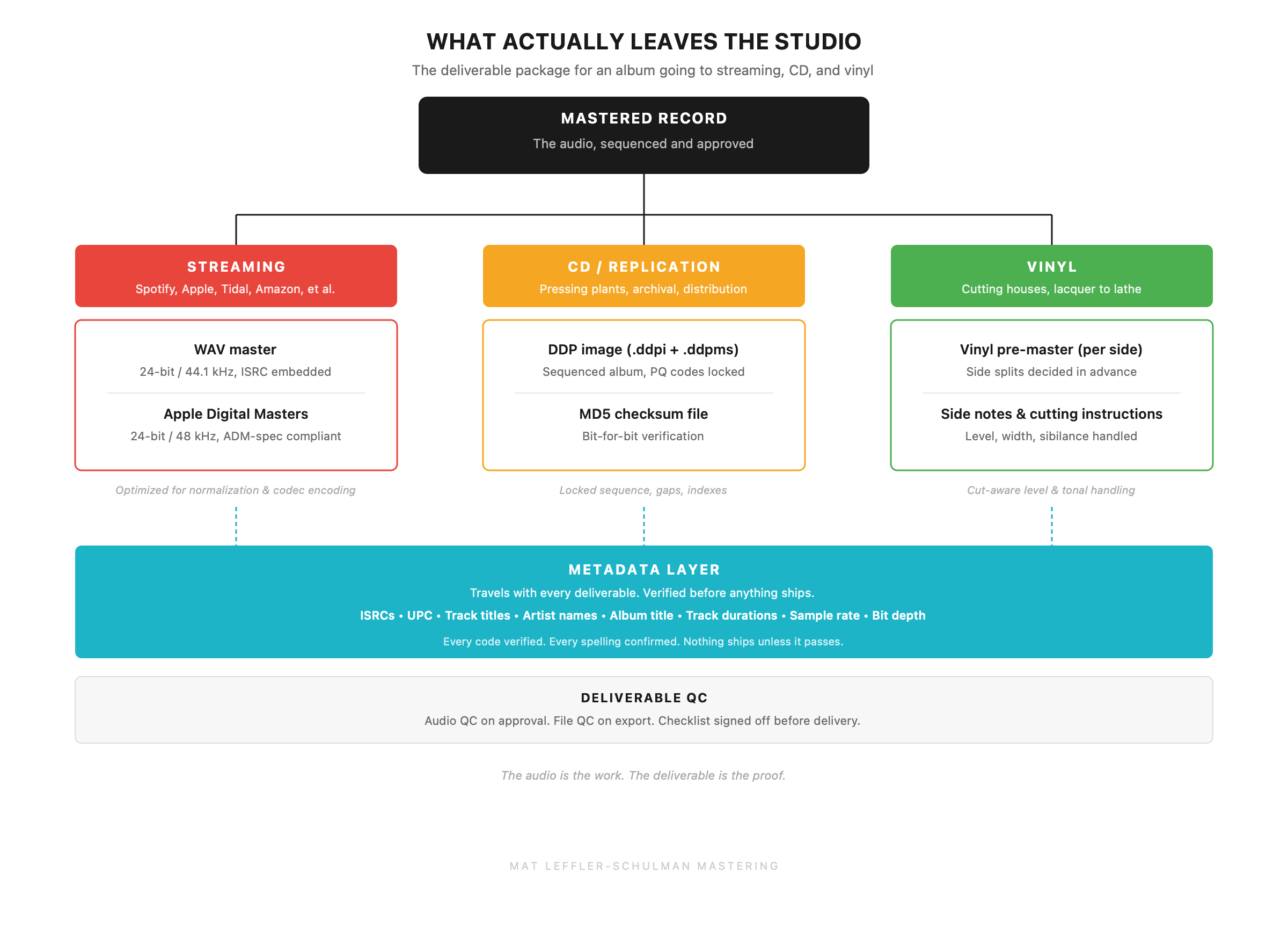
For a streaming-only single, the deliverable is typically a mastered WAV file at the appropriate bit depth and sample rate, usually with embedded metadata. For an album going to streaming and CD, the deliverable adds a DDP image of the full sequenced album. For vinyl, the deliverable adds a vinyl pre-master, typically delivered as one continuous file per side with the side timing already baked in, often at a different level and with technical adjustments that streaming would never need. For a serious release, all three may exist, and they are not interchangeable.
Each one has its own technical requirements, its own metadata layer, and its own ways of going wrong. The audio is the same conversation across all of them. Everything around the audio is different.
What a DDP Actually Is
DDP stands for Disc Description Protocol. It is a file format that contains the complete sequenced audio of an album along with the track markers, gaps, and metadata as a single, verifiable image. It was originally developed for CD authoring, which is why it still carries the structural DNA of a CD master, but it has outlived the CD itself as the standard way to deliver an assembled album to replicators, archive teams, and anyone who needs the full record (ahem) exactly as sequenced.
A DDP is not a folder of WAVs. It is a single image, with a checksum, that can be verified bit-for-bit identical to what was approved. That checksum is the point. When a DDP arrives at a pressing plant or a distributor, they can confirm that the file they have is the file you sent. No track got swapped. No metadata got rewritten. Nothing got transcoded along the way. If anything changes, the checksum fails, and we both know before a single disc gets cut.
For an album, this is the difference between sending eleven separate WAVs and hoping the order is preserved versus sending one assembled, verified, sequenced image of the entire record. Most aggregators accept both. The serious ones, and the pressing plants, prefer the DDP.
If you are working with a mastering engineer who only delivers a folder of WAVs for an album release, that is a flag. It does not mean the audio is bad. It means the assembly stage is being skipped, and the assembly stage is where sequencing, gaps, fades, and album-level QC actually live.
ISRC, UPC, and the Codes That Track the Record
ISRC stands for International Standard Recording Code. It is a twelve-character alphanumeric code, unique to a recording, that follows the recording everywhere it goes. ISRCs are how royalty agencies, streaming platforms, and radio monitoring systems know which recording is being played. Without an ISRC, a recording is anonymous on the back end, even if it is showing up on a chart on the front end.
UPC stands for Universal Product Code. It is the twelve-digit code unique to a release, not a recording. An album has one UPC. A single has one UPC. A reissue with new artwork and the same audio gets a new UPC. UPCs are how the release is tracked as a product, which is how charting and accounting work.
ISRCs are embedded in the master files. UPCs are not part of the audio at all; they live in the metadata of the release. Both need to be assigned before delivery. Both need to be correct before delivery. And both can be silently lost in transit if the delivery format does not preserve them, which is one of the main reasons DDP exists for album work.
The labels I work with assign their own ISRCs and UPCs and provide them before the master is finalized. Independent artists usually get them through their distributor. If you do not have them yet when you book mastering, that is fine; just tell me, and we will plan the delivery around when they arrive. What does not work is finishing the master, sending it out, and then realizing the codes were never embedded.
PQ Codes: The Quiet Layer Inside a CD Master
PQ codes are the structural metadata of a CD master. They define where each track starts, where each track ends, how long the gaps between tracks are, and where the index points sit inside a track. They are invisible to a listener but they are what makes a CD or DDP behave like an album rather than a long file with arbitrary cuts.
The length of the gap between two tracks is a creative choice that affects how the album feels. A two-second gap between two songs that should flow into each other breaks the moment. A zero-second gap between two songs that should breathe between each other makes the second one feel rushed. PQ is where those decisions get made and locked in.
This work happens at the mastering stage and nowhere else. A producer or label sending in track-level masters and assuming the distributor will sequence the album correctly is making an assumption that does not survive contact with reality. The aggregator will preserve the order you uploaded. They will not preserve the gaps you wanted. They will not preserve the index points. They will not catch a fade that was supposed to crossfade into the next track.
If the album is meant to be experienced as an album, the PQ layer is part of the master, and it leaves the studio inside the DDP.
Streaming, Vinyl, CD: Three Different Deliverables
A record going to streaming, vinyl, and CD does not get the same file delivered three ways. It gets three masters from one session, each prepared for the format it is going to.
The streaming master is optimized for normalization, codec encoding, and a wide range of playback systems. It uses the appropriate bit depth and sample rate for the platform, often 24-bit / 44.1 kHz for general streaming and at the native session sample rate, minimum 24-bit, for Apple Digital Masters. The loudness is targeted to translate well after platform normalization, which is not the same as targeting a specific LUFS number.
The vinyl pre-master is a different file entirely. It is typically at a lower level, with elements like sibilance, hard panning at low frequencies, and any extreme stereo width handled specifically for the cutting head. The side splits are determined in advance. The level can vary across sides depending on what each side contains. A vinyl pre-master delivered as "the streaming master with the limiter backed off" is not a vinyl pre-master.
The CD master is delivered as a DDP, with PQ codes in place, with the assembled sequence locked. CDs are a low-volume format now, but for the artists and labels who still press them, the deliverable is real, and the format is unforgiving. A CD with bad PQ is a problem at the replication plant, not a problem you can fix afterward.
Not every release needs all three. Whichever ones the release does need, each is a separate deliverable with its own considerations.
Vinyl QC happens on the pressing, not the file
Vinyl QC works differently because the production process involves more steps and more hands. After mastering, the lacquers are cut. A test lacquer, sometimes called an acetate, can be made at this stage for the client to assess before the metal parts are produced. Most clients wait and evaluate later in the process.
Once the master lacquer is used to produce the metal stampers, a short run of test pressings can be made before the full pressing run begins. Listening to test pressings is essential. Surface noise, tracking issues, distortion on the inner groove, problems with the cut itself, none of these show up anywhere else in the chain. They only show up on the pressing. Approval of the test pressing is the last checkpoint before the full run.
Clients frequently send test pressings for my review, which I am glad to do.
Not all pressing plants run their own QC on test pressings, which is one reason to favor a manufacturer that operates its own press. Fewer hands in the chain means fewer chances for something to go wrong undetected.
QC on the Files, Not Just the Audio
Most QC conversation in mastering is about the audio: did anything click, did anything distort, did the limiter do something ugly. That is the audio QC. There is also a deliverable QC, which is the part that actually catches the problems that show up in distribution.
Deliverable QC includes verifying every embedded ISRC matches the supplied list, verifying the UPC is correct on the package, verifying the track titles are spelled the way the artist actually wants them spelled (this catches more errors than people realize), verifying the artist name is consistent across all metadata fields, verifying the album title is consistent, verifying the track durations match the audio, verifying the DDP image checksums correctly, verifying the bit depth and sample rate are what was specified, verifying nothing was inadvertently downsampled or dithered twice in the export.
A checksum tells you the file transferred correctly. It does not tell you whether the master sounds right. Software can check numbers, peaks, and metadata all day, and it has zero taste. The part that requires ears, attention, and knowing what to listen for is the part that does not get delegated. All of it is the difference between a clean release and an angry email.
The mastering engineers who are best at this are the ones who treat the deliverable as a separate piece of work from the audio. The audio QC happens during the listening passes. The deliverable QC happens after the audio is approved, with a fresh checklist, and ideally with a different set of eyes than the person who exported the files.
Why Labels Ask About This First
When a label is vetting a mastering engineer they have not worked with, the audio is usually not what they ask about first. They assume the audio is going to be good. What they are actually trying to find out, in the first conversation, is whether the engineer is going to be a problem at delivery.
They want to know what formats you deliver. They want to know whether you provide a DDP for albums by default. They want to know how you handle metadata, and whether you are going to come back asking for ISRCs the day before release, or whether you are going to ask for them at the start. They want to know whether you understand that the vinyl pre-master is a separate deliverable. They want to know whether you have a QC process on the files, not just the audio.
These questions sound bureaucratic, but the label is really asking whether you are going to embarrass them at distribution. The mastering engineer who can answer all of them quickly and specifically is the mastering engineer the label calls. The one who hedges, or who treats delivery as an afterthought, is the one they hire once and never call again.