The History of the ITI Audio MEP-130 Parametric Mastering EQ Modules
Baltimore, Before All of This
To understand the ITI MEP-130, you have to start in Baltimore. Not at ITI, not even at Recordings Incorporated, but at Baltimore Polytechnic Institute, the city's legendary STEM-focused public high school whose sports teams are called, appropriately enough, the Engineers. That's where George Massenburg and Bob Meushaw were classmates, long before either of them had anything to do with professional audio.
Burgess Macneal had his own Baltimore origin story. He got his start recording the Baltimore Symphony Orchestra as a teenager, working later as a broadcast engineer before co-founding Recordings Incorporated, a studio and vinyl pressing facility. After importing one of the first Neumann microphones into the United States, Macneal and his partners built out a serious operation. It was there that Deane Jensen (yes, of Jensen Transformer fame) and a teenage George Massenburg showed up to help design a new console.
Massenburg was around 15 years old at the time.
ITI Audio's Beginnings
Shortly after work on the console began, Macneal and his business partner parted ways. Recordings Incorporated was absorbed by ITI (International Telecomm Incorporated), a company whose chief executive, Jack Best, as Massenburg would later write, 'imagined himself to be a visionary captain of industry' while producing business programs on cassette. Best had reportedly exchanged cash with Spiro Agnew for a position on the Civil Aeronautics Board. Burgess Macneal became Vice President of ITI, headquartered in Hunt Valley, Maryland. Massenburg was hired on, and the two got back to work.
The central design problem they set out to solve was an EQ with independent, continuous control of three parameters for each band: gain, frequency, and Q (bandwidth). Every equalizer that existed at the time (the Fairchild 664 console module, the Altec 9061A program EQ, the Lang Electronics PEQ-2, and the Cinema Engineering 4031B) forced you to choose from fixed frequencies, switched inductors, and interdependent controls. Macneal and Massenburg wanted to eliminate all of that. Around 1966 or '67, they conceptualized a sweep-tunable EQ that would specifically avoid inductors and switches, both expensive and, in Massenburg's assessment, "seemingly-flawed items in that day."
The first working prototype came from an unexpected direction. Meushaw, Massenburg's old classmate from Poly, had gone on to Princeton and built a three-band, frequency-adjustable, fixed-Q EQ based on passive "T" filters drawn from a 1940s Bell Labs filter handbook. The op-amps were noisy, the high-frequency section had an asymmetrical bell curve, and the interface was rough. But starting in 1968, Massenburg was using it on sessions and discovering real advantages over anything else available. It pointed the direction.
By 1969, Massenburg was spending all of his time solving the topology. He was simultaneously taking electrical engineering at Johns Hopkins, where a professor examined a gyrator circuit Massenburg had built and declared it "of theoretical interest only" and "impractical to implement." Massenburg dropped out. The gyrator, a circuit that makes a capacitor look like an inductor to the surrounding circuit with far better phase behavior and far less hum pickup, became one of the key building blocks of the parametric EQ. The professor went unacknowledged by history.
Massenburg has also described consulting a well-known engineer working nearby at Aircraft Armaments, who looked at the EQ design goals and told him the solution was impossible. That engineer's name was Walt Jung, who would later write the IC OpAmp Cookbook, the definitive reference on operational amplifier design. The impossible circuit got built anyway.
The breakthrough came during a late-night session. Massenburg worked out the parametric EQ topology, walked to Macneal's office, and drove a knife into the door with a note attached: "This is it, this works."
The Circuit: What Made It New
The paper Massenburg would present at the 1972 AES convention, submitted under the affiliation 'ITI Audio Products/ITIRI Studios, Cockeysville, Maryland,' lays out the design goals with unusual clarity for an industry paper of that era.
First, eliminate inductors. Iron-core inductors were bulky, prone to hum pickup, and increasingly unsuitable for compact, high-performance systems. The parametric EQ replaced them with T-notch filters: passive RC networks where adjusting a resistor sweeps the center frequency, and feedback around an op-amp inverts the notch into a peak. The crucial result is that Q and amplitude can be varied independently, something no inductor-based design could achieve cleanly.
Second, eliminate transformers for coupling. The paper describes "active transformers" at the input and output: amplifier stages designed to behave like transformers in terms of common-mode rejection and balanced-circuit tolerance, but without the phase shift and low-frequency limitations of iron. The MEP-130 technical manual makes this explicit: "External output transformers can be added by the user. The unfortunate fact is that even the best transformer degrades the performance of this device." Opening up a production ME-230 confirms it physically. The only transformer in the entire unit is a UTC TVC-8 in the power supply section. There are no audio signal transformers anywhere in the signal path. Despite what you may have read in Reverb listings, the ME-230 is a transformer-free audio design, exactly as the paper describes. The balanced I/O is handled entirely by active circuitry.
Third, enable automation. The paper also looked ahead to full automation, describing in its "Blue Skies Department" section how the potentiometers could eventually be replaced with FET ladders driven by BCD code for precise recall and control. In 1972, that future was still years away.
The discrete op-amp at the heart of the circuit was designed by Chick Sauter, a video electronics engineer, and used 2N4250A PNP input transistors and MPSU06/56 outputs. Massenburg later wrote that it "was not particularly stable" but was "magnitudes quieter than the available ICs of the day, and had at least 6 or 8 dB more headroom due to the higher (+/- 28v) rails." Some Los Angeles engineers, Rik Pekonnen and Allen Sides among them, have maintained that this discrete op-amp represents the cleanest EQ circuit Massenburg ever designed. Massenburg himself is unconvinced.
The Paper, the Name, and What "Parametric" Actually Means
In 1972, Massenburg presented a paper at the 42nd AES convention in Los Angeles, simply titled 'Parametric Equalization. They had missed the submission deadline, so, as Massenburg later wrote, "Burgess and I type-set (on an early IBM typesetter) and printed the pre-prints ourselves (we had a process darkroom and printing plant for record labels and jackets), under the guidelines of the AES; there's a Chemco exposure control strip on the final paper."
This is the document that coined the term "parametric equalizer." What the term describes, precisely, is an EQ in which the three fundamental parameters of a peak or dip (center frequency, Q or bandwidth, and amplitude) are each independently and continuously variable. That sounds like a low bar today, because parametric EQs are everywhere. In 1972 it was considered, by at least one senior engineer, to be impossible.
The paper is rigorous and forward-looking in equal measure. It frames the parametric EQ not just as a more flexible tone control but as the foundation for future automation, digital control, and precise spectrum modification. Fifty-plus years later, it remains the conceptual basis for the EQ in every DAW, console, and plugin in use today. You can read the original paper here.
THE MODULE, THE CONSOLE, AND THE AES DEBUT
The ITI console was completed around 1969. Only one was ever built, according to Burgess Macneal, who designed and built it. The console used Beyer input transformers, which Massenburg later acknowledged limited its low-end performance. Its EQ was a custom parametric design, but Rich Carson, who worked with Macneal on the MES-432 plugin with Make Believe Studios, has confirmed that the EQ built into the ITI console was a different design from the MEP-130. The console EQ had a separate, isolated Q knob rather than the concentric frequency and Q control that defines the MEP-130. Whether they share the same underlying topology is not documented.
The MEP-130 (Mastering Equalizer Potentiometer 130) was a separate product: a slot-in console module designed to be installed in any console with the appropriate format, in much the same way API modules could be dropped into different desks. It was not designed exclusively for the ITI console and was never installed in it. It had three fully parametric bands with the concentric frequency and Q pots that became the module's defining physical characteristic.
Macneal and Massenburg debuted the standalone rack-mount version, the ME-230 (Mastering Equalizer 230), at the 1971 AES convention in New York. The reaction was telling. Almost everyone asked the same question: "Where are the click-stops?" Gerhard Lehner of Barclay Studios in Paris was one of the few people who immediately understood what the design offered. He bought the first commercial unit. Massenburg later worked at Barclay's studio in Paris after moving there in 1973.
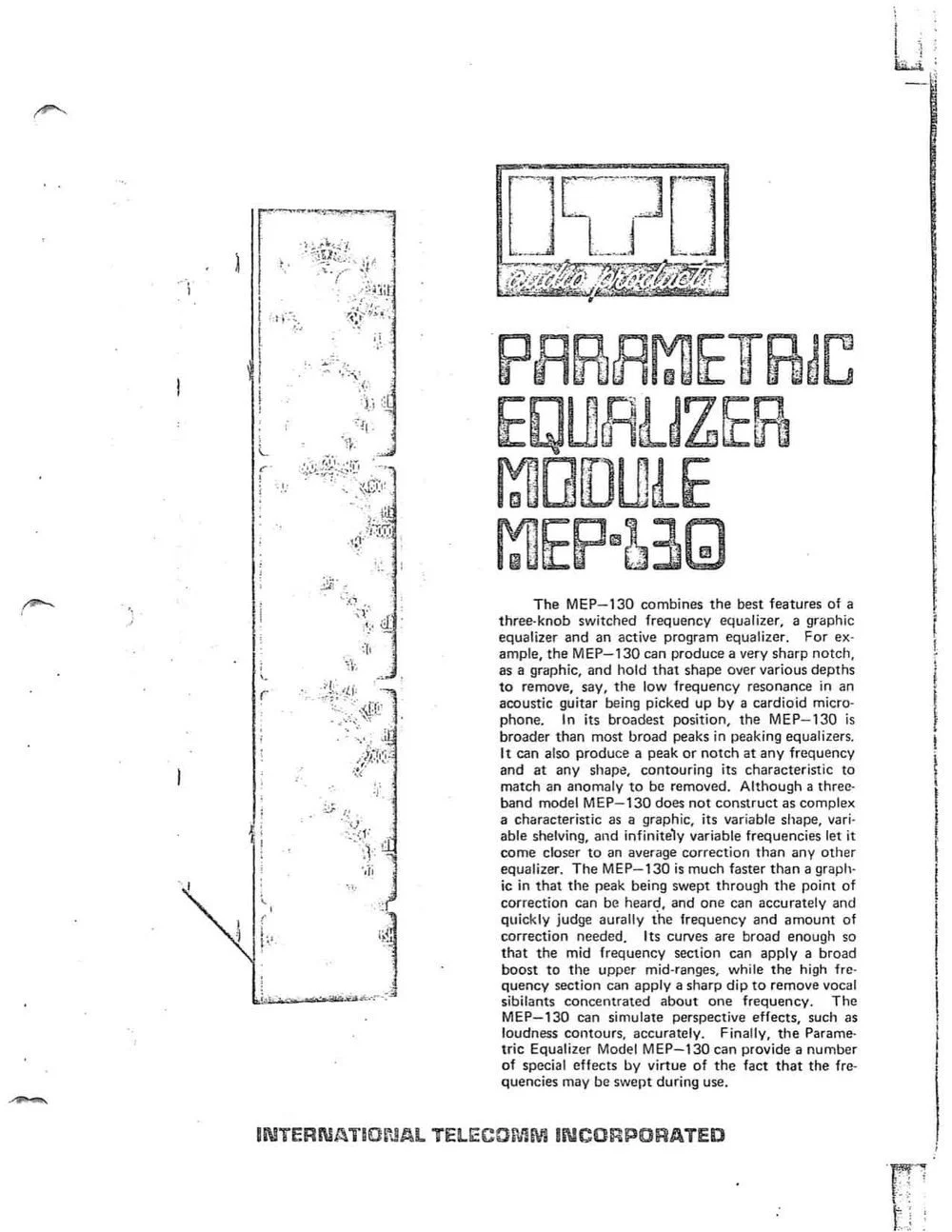
The MEP-130 continued to be sold briefly as a console module, then was repackaged in 1971 as the MEP-230A rack-mount unit. Together, they became the first commercially available fully parametric EQs. A May 1973 review and ad in dB Magazine described the MEP-130 as combining "the best features of a three-knob switched frequency equalizer, a graphic equalizer and an active program equalizer" in a single compact module. The price was $670.00 (roughly $4,900 in 2026 dollars). The export agent was Gotham Export Corporation in New York, meaning ITI was marketing internationally from the start.
The original ME-230 had a significant early problem that Macneal later described with characteristic candor: the unit inverted polarity from input to output. The commotion among buyers was considerable. ITI had to recall nearly every unit and retrofit a two-amplifier stage near the power supply to correct it. The P in MEP-230, which stands for pots, came out of that revision period. It was, Macneal said, "a real fiasco," though one the market ultimately forgave because the EQ itself sounded like nothing else available.
Around 1973, ITI produced a run of approximately 50 console modules for the Bose Corporation. What Bose intended to do with them, whether for a console, a rack installation, or some other configuration, is not documented. Macneal confirmed this order directly in a February 2023 phone conversation, and it has since been corroborated by Rich Carson. Serial numbers 001 and 002 were not part of that order. According to Doug Tomecek, who received the unit directly from Donald J. Wilke, they were a demonstration prototype built to show prospective clients what the MEP-130 modules could do in a console installation. The white developmental facing, the DJW serial prefix, and the 1976 test date are all consistent with that account.
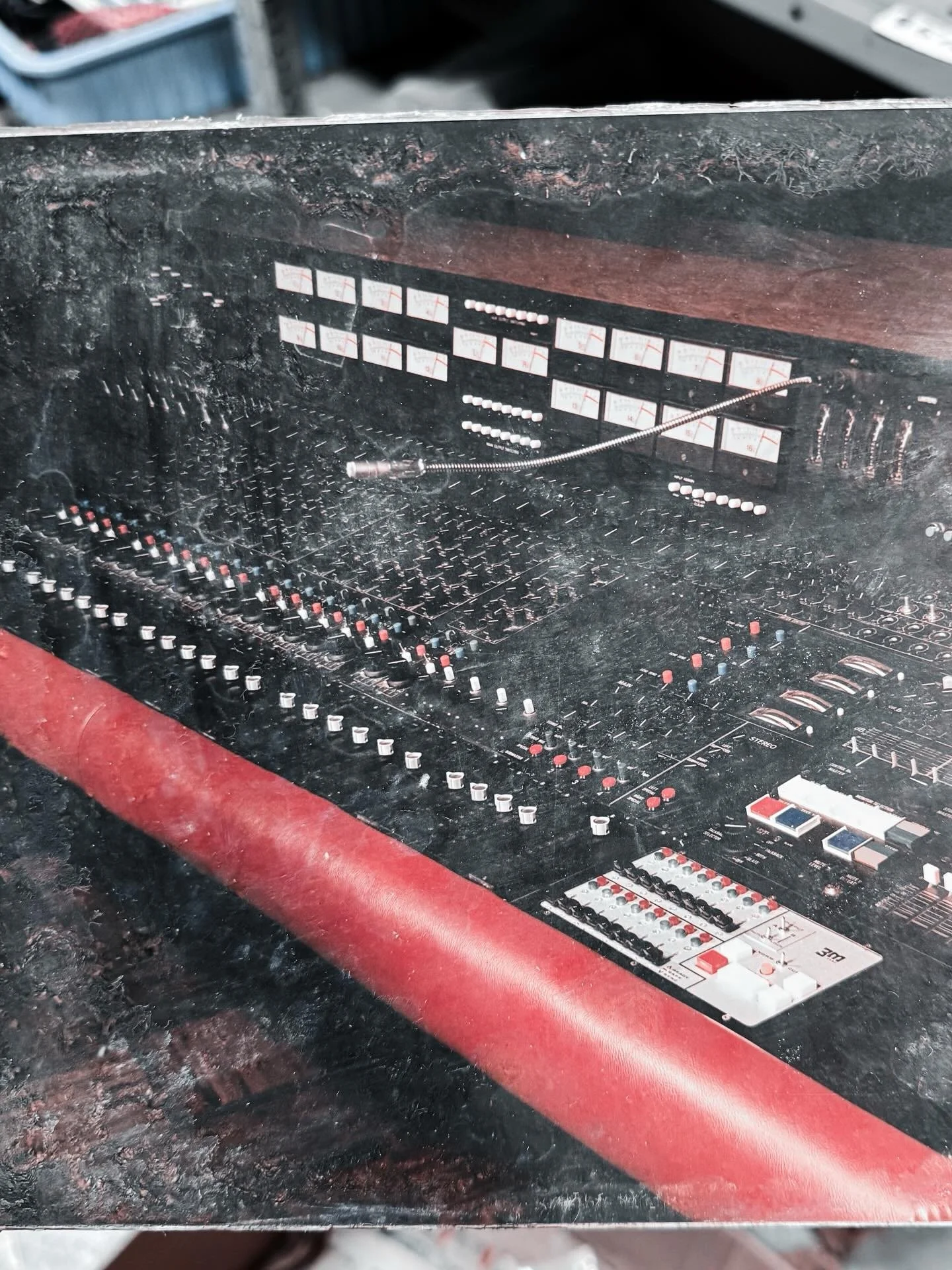
The ITI console itself had its own journey. According to Doug Tomecek, it was purchased by a company called Flight Three and later ended up on the Blue Seas barge studio in Baltimore Harbor. Doug recalled that the console had MEP-130 style parametric EQ on every channel, though whether those were production MEP-130 modules or the console's own original EQ design is not documented.
MEP-130 vs. ME-230: What Changed
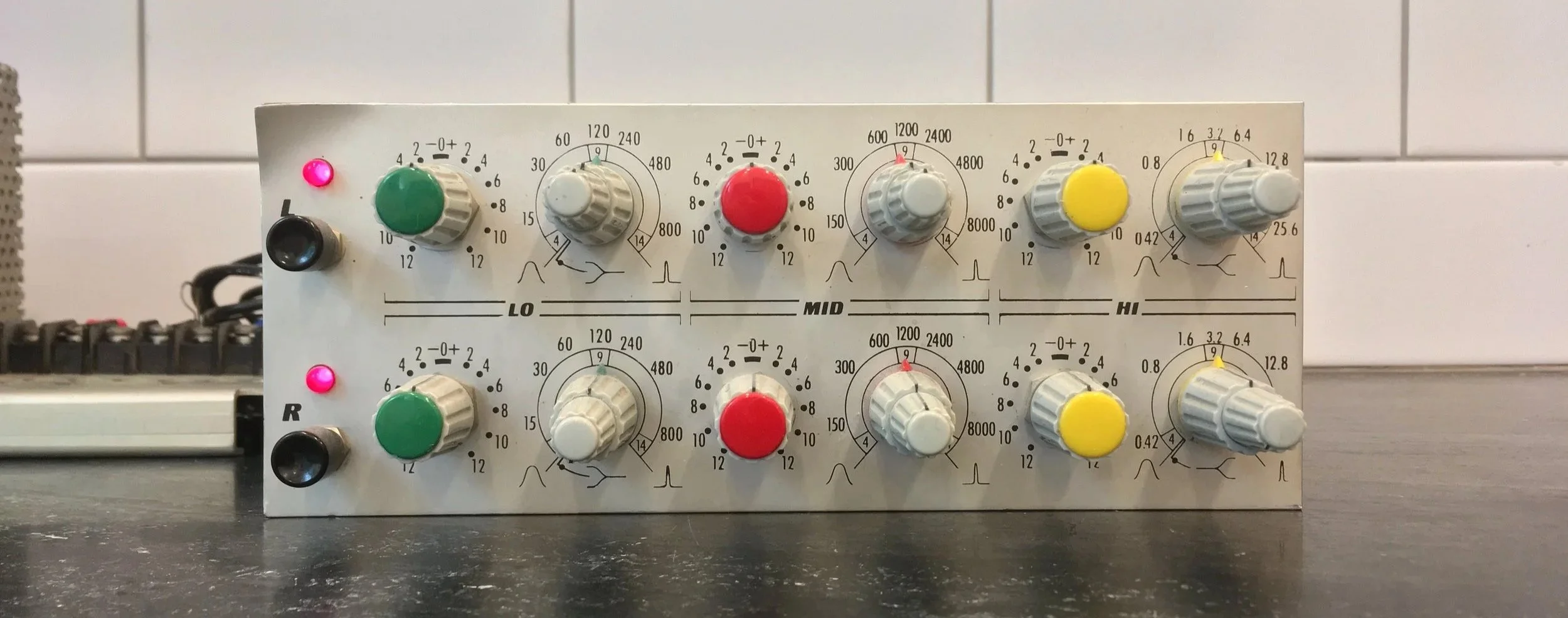
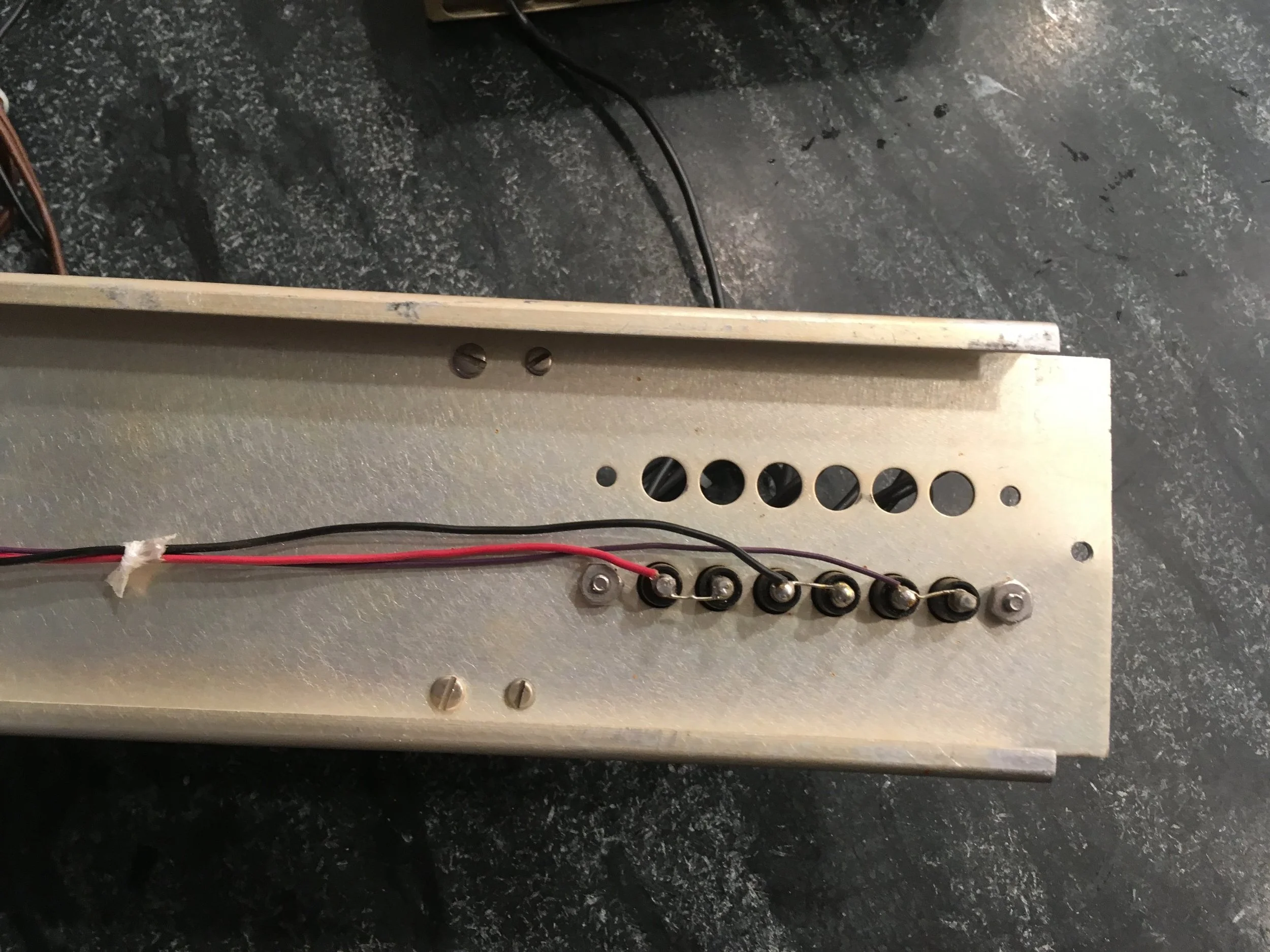
The MEP-130 is a console module. It was designed to live inside a desk, with the console's own infrastructure handling power and interfacing. Its I/O is unbalanced, as the photo of my unit makes clear, and it has no on-board transformers of any kind.
The ME-230, by contrast, is a standalone rack unit. It expanded the EQ architecture to include a fixed 10 kHz high shelf and a selectable 50 Hz / 100 Hz low shelf in addition to the three parametric bands. Balanced I/O is achieved not through audio transformers but through the active balanced amplifier stages Massenburg describes in the AES paper, stages that "behave like transformers" in terms of common-mode rejection, without the colorations and limitations of iron in the signal path. This was the whole point. The UTC TVC-8 visible inside a production ME-230 is strictly a power supply transformer. It has nothing to do with the audio signal.
The design was never patented. As Massenburg put it: "We never thought of patenting or copyrighting anything." That decision had at least one notable downstream consequence: when Dolby's attorneys later tried to levy patent fees on reciprocal EQ curves, it was an ITI manual predating the Dolby patent that established prior art and defeated the claim.
Potted and Unpotted Op-Amps and Filter Blocks
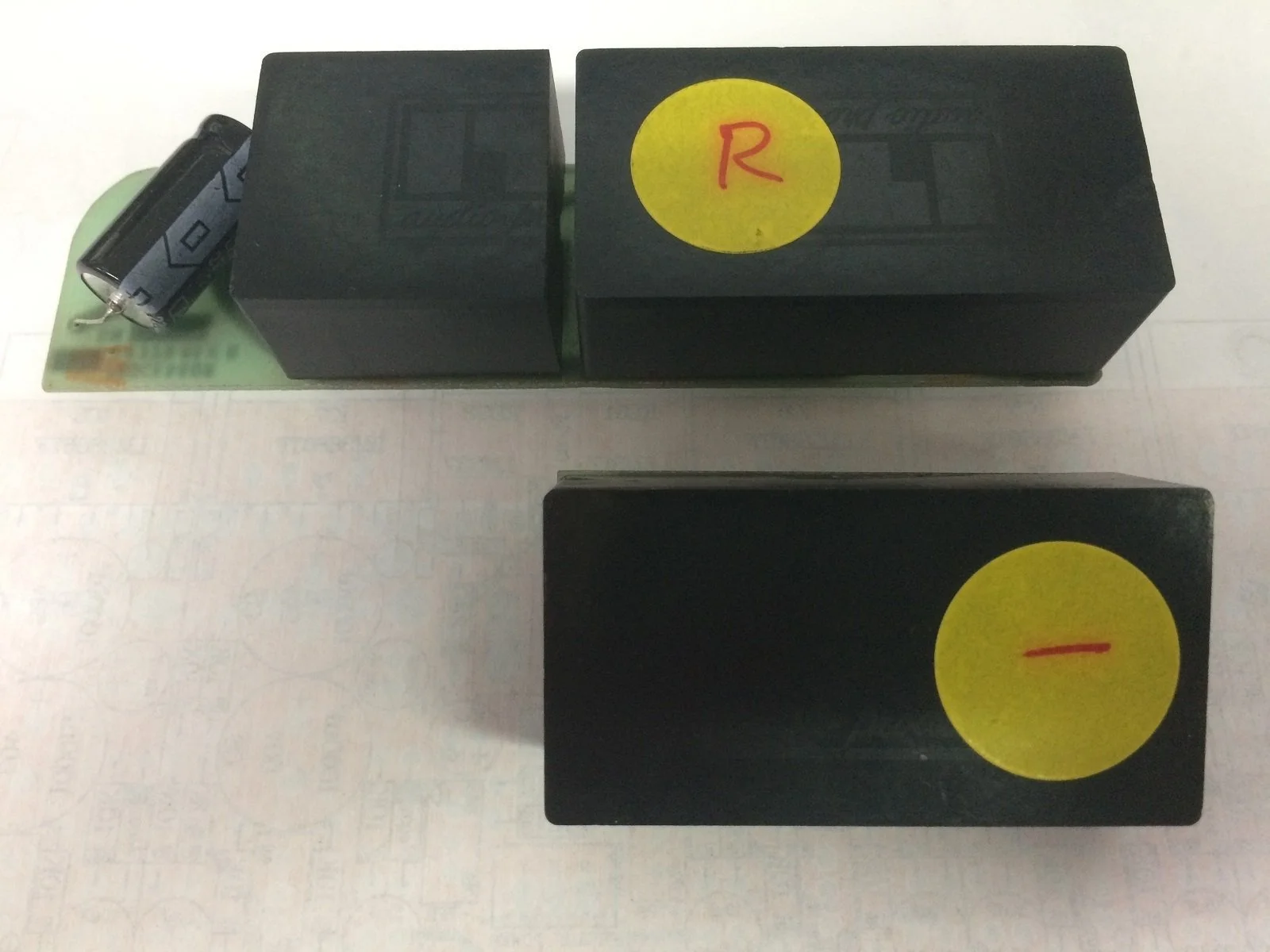
After the first two prototypes, all subsequent ITI EQs used potted op-amps and filter blocks, encased in black epoxy. This served a dual purpose: heatsinking for the output transistors, and IP protection. The topology could not easily be copied if the modules could not be opened. Replacing dead op-amps or filter blocks was possible without soldering, which was a practical maintenance advantage, but only as long as ITI kept manufacturing the modules. When ITI ceased production, failed modules had no straightforward path to repair.
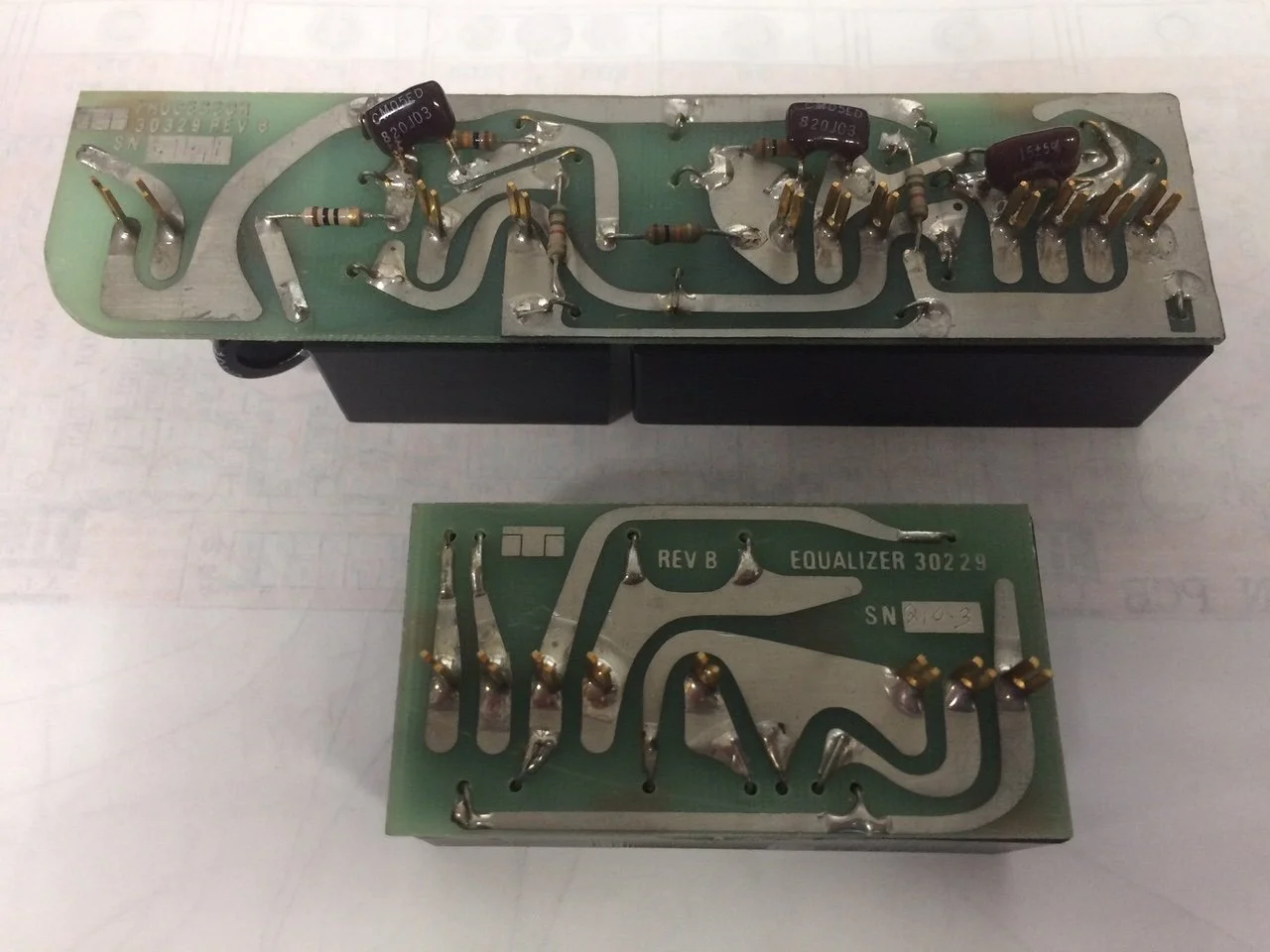
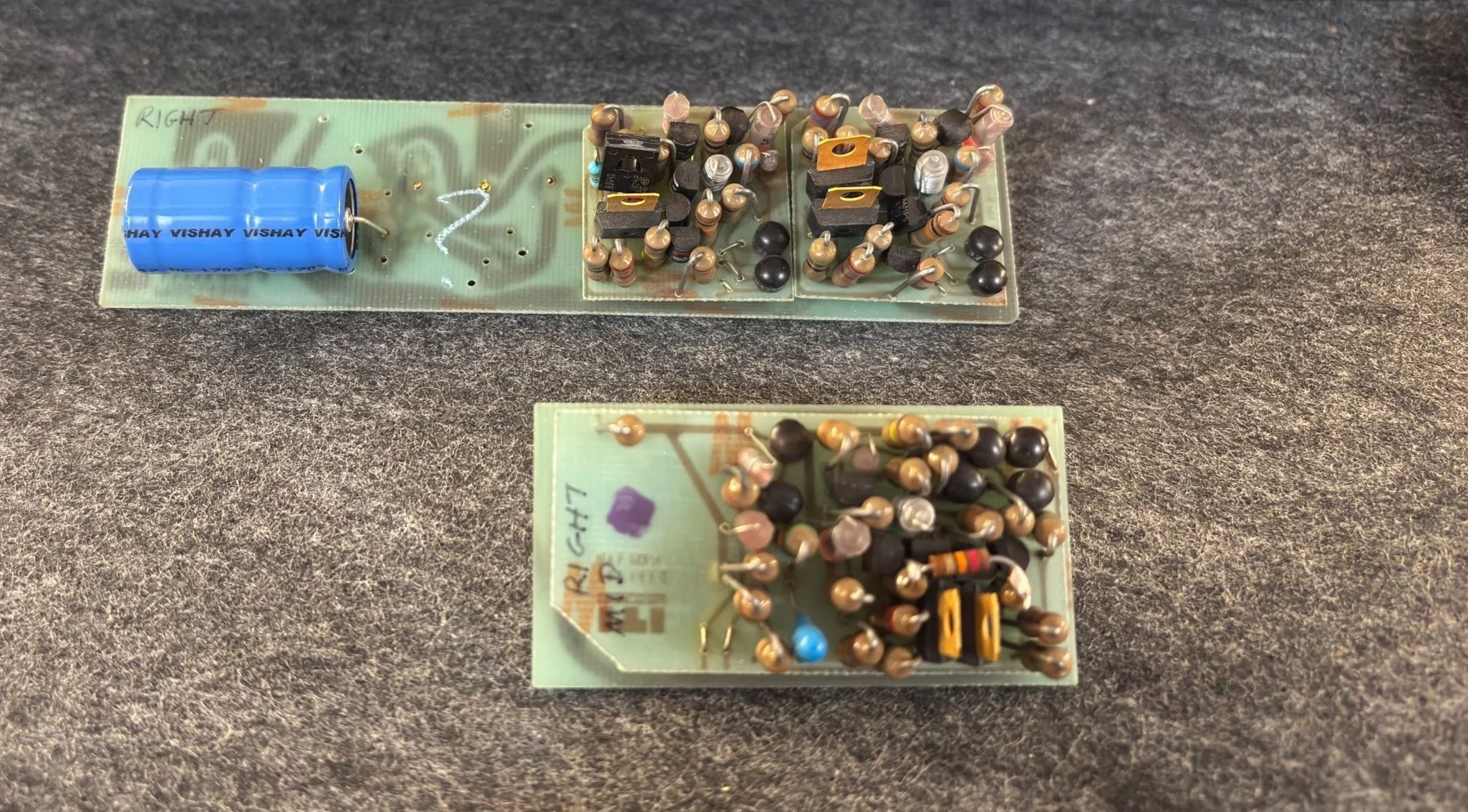
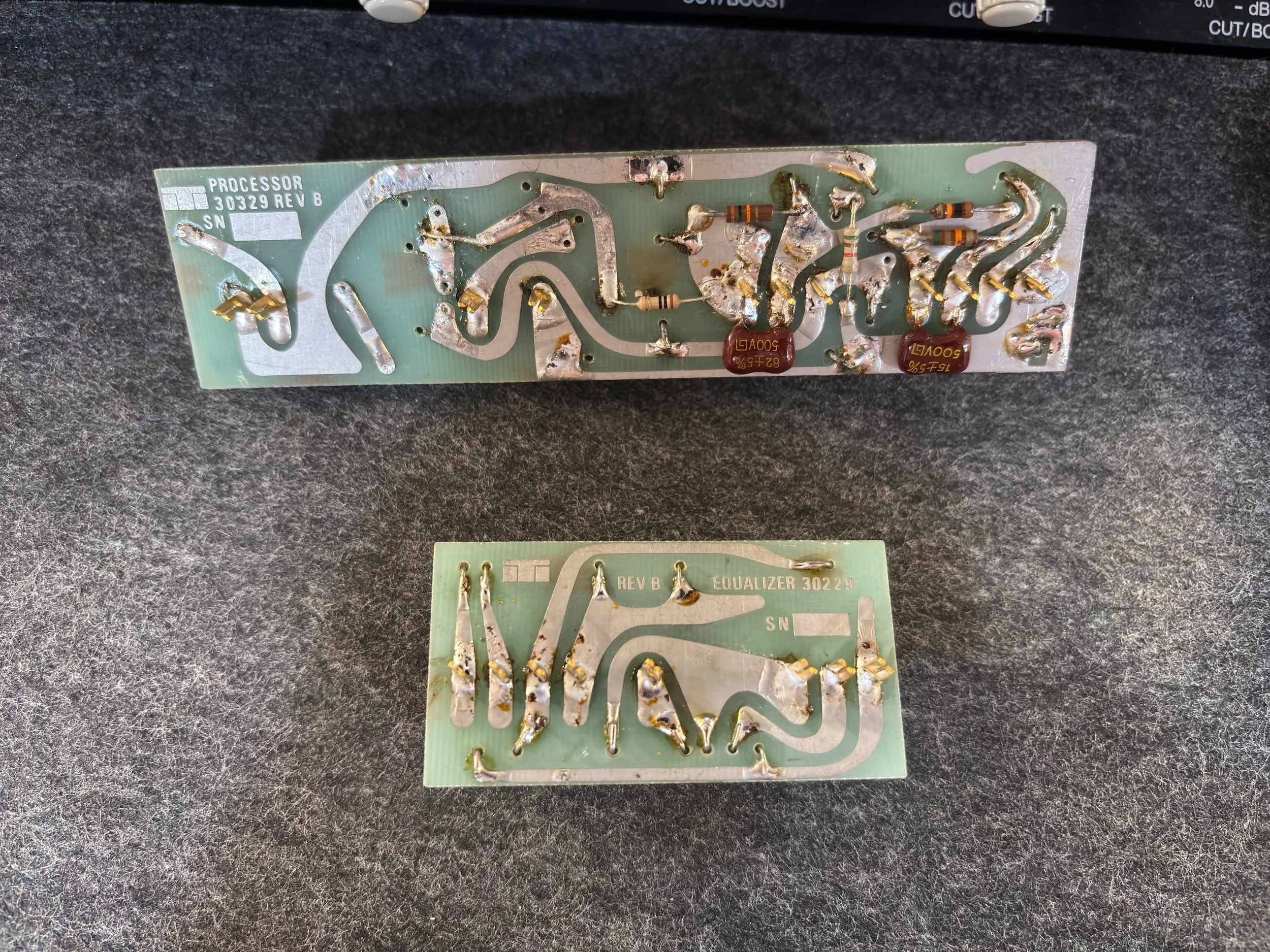
The unpotted state of serial numbers 001 and 002 has a specific explanation. In production, boards were stuffed, assembled, and tested. Once they passed, they were potted. Carolyn Macneal, who was responsible for module assembly throughout the Sontec era and familiar with every production variant, identified these units as early based on the resistor orientation: one end soldered to the board, the other end standing upright and bent over, a construction technique from the earliest production runs. Macneal's conclusion was that these boards passed their tests but were pulled from the line before the potting stage, most likely "spirited out of ITI production" by someone with access. They are production-tested units that never completed the full production process. That is why they can be opened, examined, and repaired in ways that no standard ITI EQ can.
What the serial numbers 001 and 002 mean precisely is unclear. They are among the earliest MEP-130 modules known to survive, and Macneal's assessment that they were pulled before potting places them at the very beginning of production. Whether anything came before them, under a different prefix or numbering scheme, is not documented.
Under the Hood: Specs and Quirks
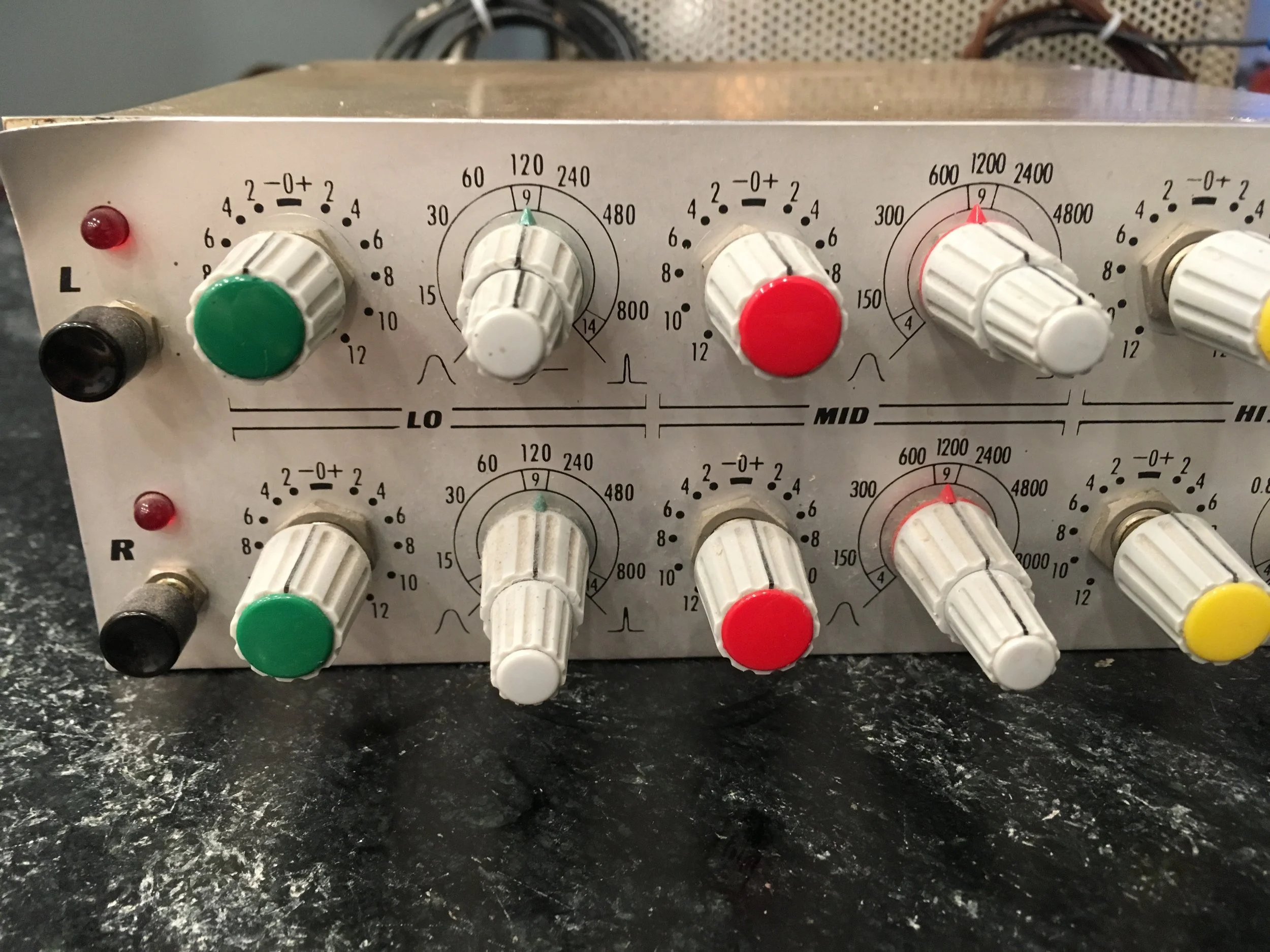
The MEP-130 has three parametric bands with broadly overlapping frequency ranges: Low covers 10 to 800 Hz, Mid covers 100 to 8,000 Hz, and High covers 400 to 25,600 Hz. Each band gives you independent control of frequency, level (plus or minus 12 dB), and shape (Q), with the frequency and Q controls concentric on the same knob.
Here is where it gets interesting. On the Low and High bands, turning the Q control fully counter-clockwise produces a satisfying click. That click is not just a detent. It is a mode change baked into the circuit itself, switching the band from a parametric peak or dip into a continuously variable frequency shelf. The corner frequency of that shelf is then set by the frequency knob. So the Low and High bands each do double duty: peak or shelf, your choice, per band. The Mid band stays parametric throughout its range.
The bypass switching is equally thoughtful. Rather than a hard relay or switch contact, the in/out switching uses a Vactec VTL9A9 cadmium sulfide photocell, making the bypass completely transient-free. You can switch the EQ in and out during a take without a click or thump.
The op-amps in serial numbers 001 and 002 predate both the HS-1000 and HS-2000 series that ITI and Sontec used in later production units. The HS-1000s, found in the original MEP-230 and MES-430 series, were considered slightly more colored and musical. The HS-2000s, used in the MES-432 series, leaned more transparent. The discrete unpotted 30329 Rev B processor boards (op-amp) and 30229 Rev B equalizer boards (filter module) in these two modules sit before either of those designations entirely. Whatever character they have is not the refined Sontec sound, and not the later ITI sound. It is the original circuit, unchanged, from 1969.
The 430 series rack units added a dedicated op-amp for the shelving bands and a separate output line driver, a distinction from the later MEP-250 line that longtime users describe as audibly significant. The MEP-130 console modules predate all of it.
The Numbers
The published electrical specs are impressive enough on their own. Input impedance is 100,000 ohms balanced, output impedance is 10 ohms, frequency response is 10 to 40,000 Hz plus or minus 0.1 dB at 1kHz reference, THD is less than 0.03% at any level up to clipping, and maximum output is plus 24 dBm. The noise floor sits at minus 95 dBm with EQ out and minus 84 dBm with EQ in. That 10 ohm output impedance is worth pausing on: it means the MEP-130 will drive virtually any load without degradation, and the manual notes that the output can safely be shorted to ground without damage.
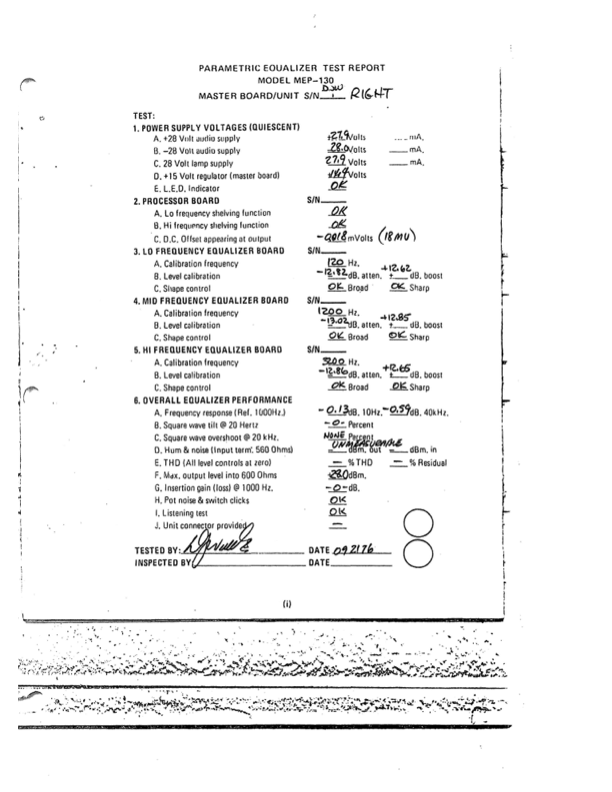
Before shipping, each unit was performance verified and burned in for 72 hours. The test reports are the paper trail of that process.
DJW, the Barge, and the 1976 Mystery
The DJW prefix in the serial number DJW 001 002 also has an answer now. When shown the serial number, Macneal identified it immediately: DJW stands for Donald J. Wilke, the second in command at ITI and one of its major shareholders. Macneal noted that Wilke was never involved in the manuals or documentation side of the operation, which makes the prefix puzzling even to him.
Doug Tomecek's account offers the most direct explanation. Tomecek knew Wilke personally for around fifty years, having first met him at the Social Security Administration government studio in the late 1970s, where Wilke had taken engineering work after ITI wound down. It was Wilke himself who described the unit to Tomecek as a prototype built for client demonstrations, and it was Wilke who gave it to Tomecek around 1978 to 1980, saying he had no more use for it. Wilke had also built a custom wood cabinet for the unit, not an ITI production item, which suggests he had been actively using it for some period after the company closed. After the ITI auction, Sontec later built a console for the Social Security Administration's in-house production studio. The Craigslist listing that came with the units is reproduced and evaluated in the section below.
For context on how rare these units are: Macneal confirmed in 2023 that ITI built approximately 25 to 30 two-module pairs for Sheffield Recording. John Ariosa sold around 10 to 12 of them individually after Sheffield decommissioned the console. Some were later refurbished and put into wooden carrying cases with power supplies. Those are the other ITI units that occasionally surface on Reverb and eBay. These are distinct from the Sheffield console purchased at the ITI auction.
The original factory test report for my unit, serial number 1 Right channel, dated September 21, 1976, tells an even better story. Maximum output into 600 ohms measured at plus 28.0 dBm, four dB beyond the published spec. Insertion gain at 1kHz was exactly 0 dB. Frequency response measured minus 0.13 dB at 10 Hz and minus 0.59 dB at 40 kHz. Square wave tilt at 20 Hz was zero percent. Square wave overshoot at 20 kHz was none. DC offset at the output was 18 microvolts. And THD? Unmeasurable. Not low. Not within spec. Unmeasurable, meaning distortion fell below the threshold of whatever test equipment was on the bench in 1976.
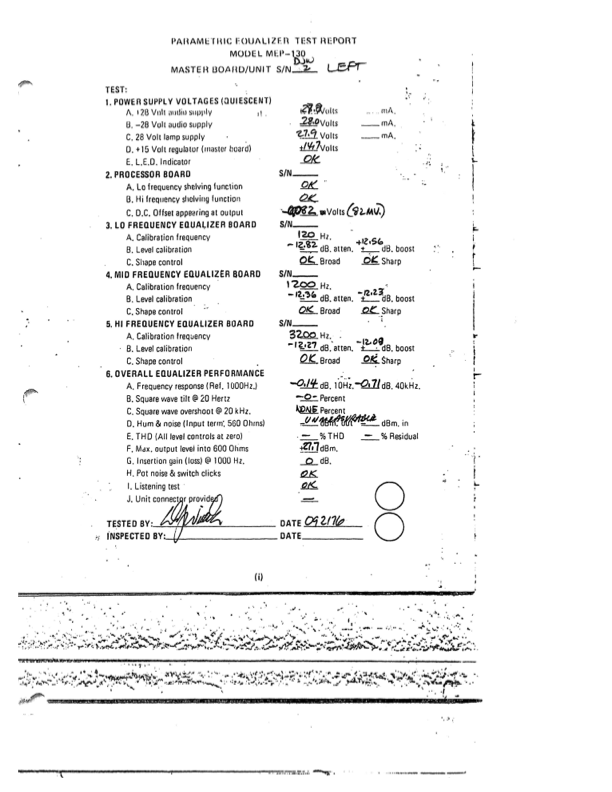
The Left channel report from the same date tells an equally clean story, with both channels measuring within 0.3 dB of each other on maximum output and fractions of a dB on frequency response across the band. For a discrete stereo unit built in 1969, the channel matching is remarkable.
The test date of September 21, 1976 is itself a small mystery. ITI had been dissolved nearly two years earlier, yet here are serial numbers 001 and 002 being tested on ITI letterhead. The Blue Seas barge had already sunk by this point, and the sequence of events surrounding the console requires some untangling.
Macneal gave the most detailed account of the sinking in a 2023 conversation. The Blue Seas crew, he said, came back late one night having "inhaled stuff they shouldn't have," went to bed, and forgot to turn on the sump pumps. They woke at three or four in the morning to find water sloshing around the bottoms of their beds. By then it was too late to reach the controls. The barge sank approximately six to eight feet before the mooring lines went taut and stopped it, which put it roughly where the National Aquarium was eventually built. The Dolby units and the multitrack machine were destroyed. The console was underwater.
Macneal was asked about salvaging the equipment and declined. "You start getting pots full of salt water," he said. "You can make them work sometimes, but not guaranteed." He could not put his name on work like that. A certain amount was salvaged by others. The rest stayed where it was.
Whether serial numbers 001 and 002 spent any time underwater before ending up on a test bench in September 1976 is a question the paperwork alone cannot answer. Whatever route they took from the ITI production floor to that Craigslist listing, they arrived clean, tested, and functioning.
Power requirements are plus and minus 28 VDC at 70 mA. ITI sold companion power supplies for studio installations: the PSE-120 for up to two units, the PSE-240 for up to four, and the PSE-416 for up to sixteen.
Sound and Lineage
The MEP-130 is not a neutral tool. Macneal described the amplifier character in plain terms: "no slew rate," he said, "a bit of second harmonic distortion, but really warm and really punchy." Those qualities are connected. The low slew rate means the circuit responds slowly to fast transient edges, softening and rounding them in a way that feels less like limiting and more like heft. The second harmonic distortion adds body and presence. Together they give the unit a quality that is difficult to name precisely but easy to recognize: a tape-like character that takes the edge off without dulling the picture. The high frequencies have an airiness that does not call attention to itself, and the low end responds with sculpted weight rather than thump.
Macneal himself described the ME-230, which shares the same core circuit, as "way more muscular and obvious" than the Sontec units that followed. Some engineers find it too heavy-handed for mastering. Others reach for it precisely because of that quality. In practice it is a specific tool rather than an all-purpose one, particularly effective on low end and midrange, and less suited to mixes that are already warm or dark. The MEP-130 console modules share that character, with the added dimension of running the signal through the circuit itself, even flat, for what the box adds in transit.
In use, the MEP-130 and ME-230 occupy their own territory at the colored end of the ITI/Sontec lineage. The MES-430 and MES-432, which followed, moved decisively toward transparency, with a musical quality that engineers describe as an expensive sheen rather than overt coloration. The MEP-250 A, B, and C moved further still with IC op-amps. The MEP-250EX, a complete redesign, is clean and open with a subtle sweetness and a particularly strong high shelf that brightens without brittleness. Each step in the lineage was a move away from what the MEP-130 sounds like. The discrete 30329 Rev B processor boards in serial numbers 001 and 002 predate all of it. Whatever the MEP-130 sounds like, it is not the Sontec sound, and it is not the later ITI sound. It is something that existed before either of those things had a name.
| Model | Era | Op-Amp | Feature Set | Character |
|---|---|---|---|---|
| ITI Console EQ | ~1969 | Undocumented | Built-in parametric EQ for the one-off ITI console. Separate, isolated Q knob rather than the concentric frequency/Q control of the MEP-130. Beyer input transformers at input. Output transformer in signal path. Exact band configuration and full feature set undocumented. | Undocumented. Rich Carson has confirmed the design was distinct from the MEP-130 module. Massenburg later acknowledged the Beyer input transformers limited the console's low-end performance. |
| MEP-130 | 1969 | Chick Sauter discrete, 30329 Rev B | 3 parametric bands. Low and High bands switchable to variable frequency shelves via Q control turned fully CCW. Continuously variable Q, frequency, and gain. Q range: 4–14 dB/octave. Gain: ±12dB. Unbalanced I/O. No onboard power supply. Slot-in console module designed for installation in any compatible console. | Forward and dense with a strong tonal imprint. Capable of both broad shaping and targeted moves, with a Q control that is responsive and musically precise in practice. Subtle harmonic contribution and limited slew behavior contribute to transient softening and low-frequency weight. |
| ME-230 / MEP-230 | 1969 – early 1970s | Chick Sauter discrete, 30329 Rev B | 3 parametric bands plus dedicated fixed 10kHz high shelf and switchable 50/100Hz low shelf. Continuously variable Q and frequency. Gain: ±12dB. Active balanced I/O. Standalone rack unit with onboard power supply. | Shares the core topology of the MEP-130 in a self-contained format. Still colored and assertive, with slightly greater stability and consistency. Broad, musical shaping with the ability for controlled, targeted adjustments. Harmonic content and bandwidth constraints contribute to a cohesive, warm presentation. |
| MES-430 | Early 1970s | HS-1000 | 3 parametric bands plus 2 dedicated shelf bands per channel. 72 stepped frequency positions across 3 overlapping ranges: 11–570Hz, 125Hz–6.8kHz, 3.4–25kHz. Stepped Q at 5, 6, 9, 11, 15 dB/octave. Stepped gain. Low shelf: 50 or 100Hz switchable. High shelf: fixed 10kHz. Dedicated shelf op-amp and output line driver. 4U rack. Soft bypass. | Highly transparent and precise relative to earlier designs. Maintains musicality with minimal audible coloration. More fluid character than the 432. Extended bandwidth and improved linearity produce a refined high-frequency presentation. Dedicated shelving amplifier and output line driver contribute to clarity and stability. |
| MES-432 | 1970s onward | HS-2000 series | Same architecture as MES-430. 72 stepped frequency positions across 3 overlapping ranges: 11–570Hz, 125Hz–6.8kHz, 3.4–25kHz. Stepped Q at 5, 6, 9, 11, 15 dB/octave. Gain varies by model: ±6dB, ±9dB, or ±12dB in stepped increments. Low shelf: 50 or 100Hz switchable. High shelf: fixed 10kHz on earlier units, switchable 7 or 12kHz on later versions. 4U rack. Soft bypass. | Highly transparent and controlled. Similar tonal balance to the 430 but faster and more precise. Slightly tighter filter behavior and reduced harmonic contribution. Perceptually more neutral, with a more clinical presentation under critical listening. |
| MEP-250 A/B/C | Mid 1970s onward | IC based | 3 parametric bands plus dedicated low and high shelf bands. Continuously variable pots. Gain: ±12dB with 0dB detent. Frequency range approximately 10Hz to 27kHz. Active balanced I/O. 2U rack. | Clean and linear. IC-based design reduces harmonic coloration and increases consistency. More predictable and repeatable behavior, with less sonic imprint compared to earlier discrete designs. |
| MEP-250EX | 1987 onward | New discrete design | Same band architecture as MEP-250 A/B/C. Complete discrete redesign at tuning stage. Approximately 6dB more headroom in equalization circuits. Lower noise floor than A/B/C. Continuously variable pots. Active balanced I/O. 2U rack. | Clean and open with subtle tonal density. Improved low-frequency solidity and headroom. High-frequency shelving remains smooth under boost, avoiding edge or brittleness. Lower noise floor and greater dynamic range than earlier 250 revisions. |
NOTES
The ITI Console EQ row reflects limited documentation. It is included to distinguish the console's built-in EQ from the MEP-130 module, which was a separate product not installed in the ITI console. Rich Carson confirmed the two designs were different. Further details have not been established from primary sources.
The MEP-130 vs ME-230 comparison is based on circuit analysis and Burgess Macneal's own descriptions rather than controlled listening tests. Direct A/B evaluation is pending.
Originally designed as console modules, most surviving MEP-130 units are now racked with external power supplies. As a result, performance is generally more standardized than in their original console installations.
The MEP-230 designation followed a recall to correct a polarity inversion in early units. The P stands for pots. Same circuit, same op-amp, corrected output stage. The ME-230 row in the chart covers both designations.
ITI's End, and How Sontec Began
ITI's engineering department refused to manufacture the prototype recording consoles, and the company slid into financial difficulty. In January 1975, the bank auctioned the company's assets. Massenburg, backed by Earth, Wind & Fire, purchased the music recording studio. A Nashville company bought the mastering studio. John Ariosa from Sheffield Recordings bought the voice-over production studio, which included the original ITI EQ prototype and several Little Feat masters.
Macneal made the most consequential purchase. He bought the vinyl pressing plant, the equalizers, the intellectual property, the engineering drawings, and the front panels and chassis, all for $75. He rehired the ITI staff, set up production in his house with Carolyn overseeing assembly, and relaunched under the name Sontec, operating from 10120 Marble Court in Cockeysville, the same industrial complex where ITI had been built. The first customer was Sterling Sound, which still uses their Sontecs. Sontec EQs subsequently became standard at most of the world's major mastering studios, including Masterdisk in Manhattan and the Capitol Records mastering studio in Los Angeles. Massenburg later confirmed that he and Macneal jointly own Sontec, along with others, though this has rarely been publicly acknowledged.
Massenburg founded GML in 1982, producing the GML 8200, a direct refinement of the parametric topology he had first worked out in Hunt Valley fifteen years earlier. The same circuit, evolved. In 2005, he was inducted into the TECnology Hall of Fame for the 1969 invention.
The Sontec MEP-250 went through several iterations. The MEP-250A, MEP-250B, and MEP-250C were all built around an IC at the tuning stage and were internally similar to each other. Around 1987, when key components were discontinued, Macneal did a complete redesign switching to a discrete amplifier at the tuning stage. The result was the MEP-250EX, which was quieter in EQ mode and had roughly 6dB more headroom in the equalization circuits. The A, B, and C are IC designs. The EX is something different. All of them trace back to that late-night note, the knife in the office door, and a circuit that a Johns Hopkins professor said couldn't be built.
Alongside the MEP-250 line, Macneal also developed the MES series, the Mastering Equalizer Switches, which used fixed frequencies and stepped level controls specifically designed for vinyl cutting. The MES-430 and MES-432 became the units most associated with the Sontec name in major mastering studios and are still considered among the finest mastering EQs ever made. The frequencies that made them legendary were not the result of extensive research. Macneal later admitted that he and Massenburg simply divided the spectrum into half octaves and third octaves and calculated the values with a slide rule. The holy grail of mastering EQs was designed in an afternoon.
The Great Find on Craigslist
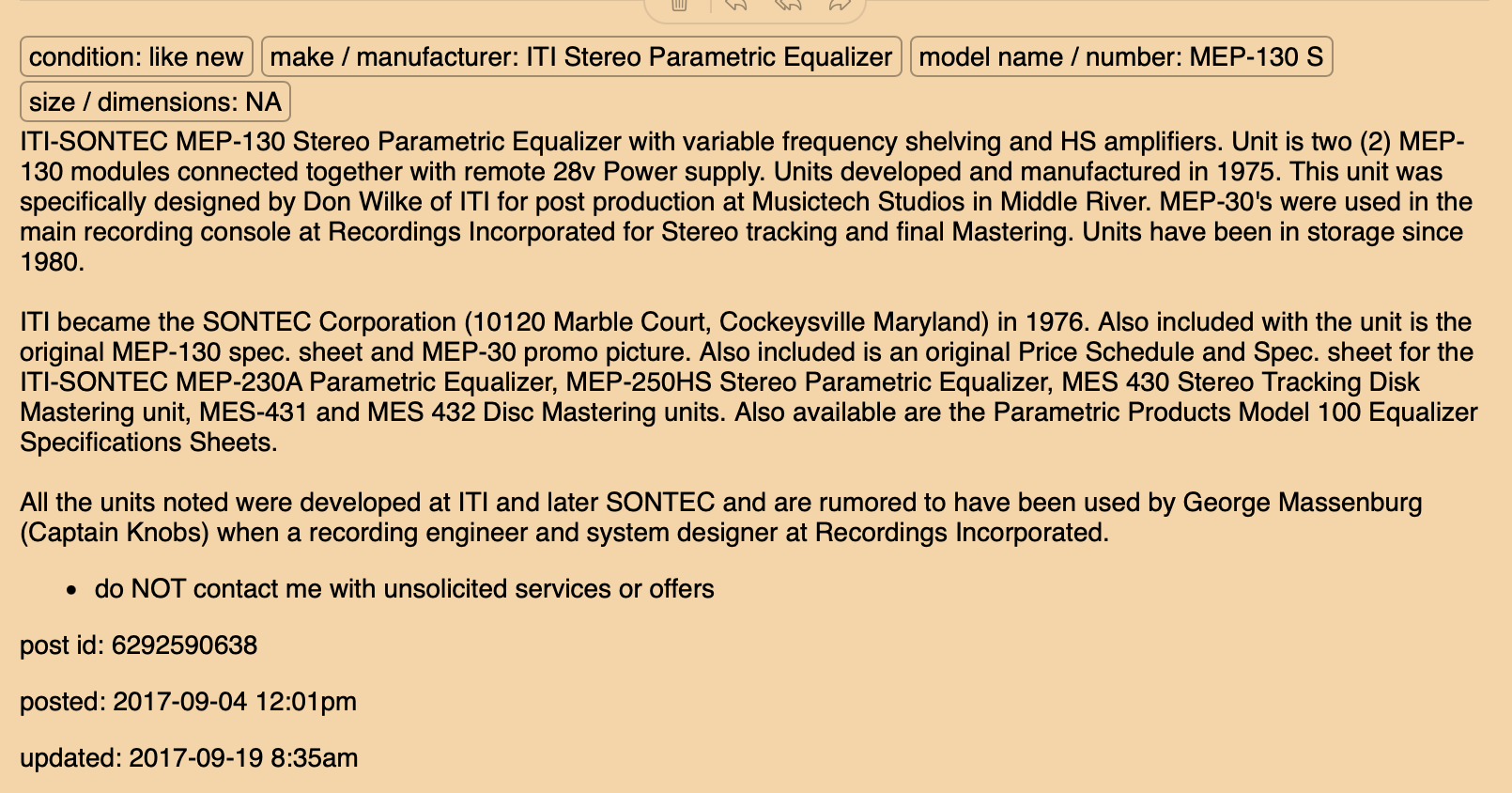
A few things in the listing are accurate. The storage-since-1980 date is consistent with Tomecek's account. The Sontec address, 10120 Marble Court, Cockeysville, is correct. The paperwork included with the sale was genuine, as documented elsewhere in this article. A few things are imprecise or wrong. "ITI-SONTEC" was never a brand name; ITI and Sontec were sequential companies, not simultaneous ones. The claim that "MEP-130s were used in the main recording console at Recordings Incorporated" conflates two distinct designs: the ITI console had its own parametric EQ, which Rich Carson has confirmed was a different design from the MEP-130 module. The claim about Massenburg's involvement being a rumor is, at minimum, an understatement: he co-designed the entire product line. And the "variable frequency shelving and HS amplifiers" description more accurately fits the later MEP-250HS than the MEP-130 modules, which have no HS amplifiers and predate that designation entirely.
It turned out to be a genuine pair of MEP-130 console modules, and not from any production run. According to Doug Tomecek, who received them directly from Donald J. Wilke, these were a client demonstration prototype: a working unit ITI used to show prospective buyers what the MEP-130 modules could do before committing to an installation. In Wilke's own words to Tomecek, it was "one of the prototypes that were made that you used to use for demos, demonstrations, to show the client with the product locally."
Doug Tomecek's account offers the most direct explanation. Tomecek knew Wilke personally for around fifty years, having first met him at the Social Security Administration government studio in the late 1970s, where Tomecek was already working when Wilke arrived looking for engineering work after ITI wound down. Wilke was second in command at ITI and one of its major shareholders, though not its chief engineer as Tomecek remembered him. It was Wilke himself who described the unit to Tomecek as a prototype built for client demonstrations, and it was Wilke who gave it to Tomecek around 1978 to 1980, saying he had no more use for it. Wilke had also built a custom wood cabinet for the unit, not an ITI production item, which suggests he had been actively using it for some period after the company closed. After the ITI auction, Sontec later built a console for the Social Security Administration's in-house production studio. The Craigslist listing that came with the units is reproduced and evaluated in the section below.
I bought them without knowing whether they would pass signal safely.
Joe From JLM Audio Restoration
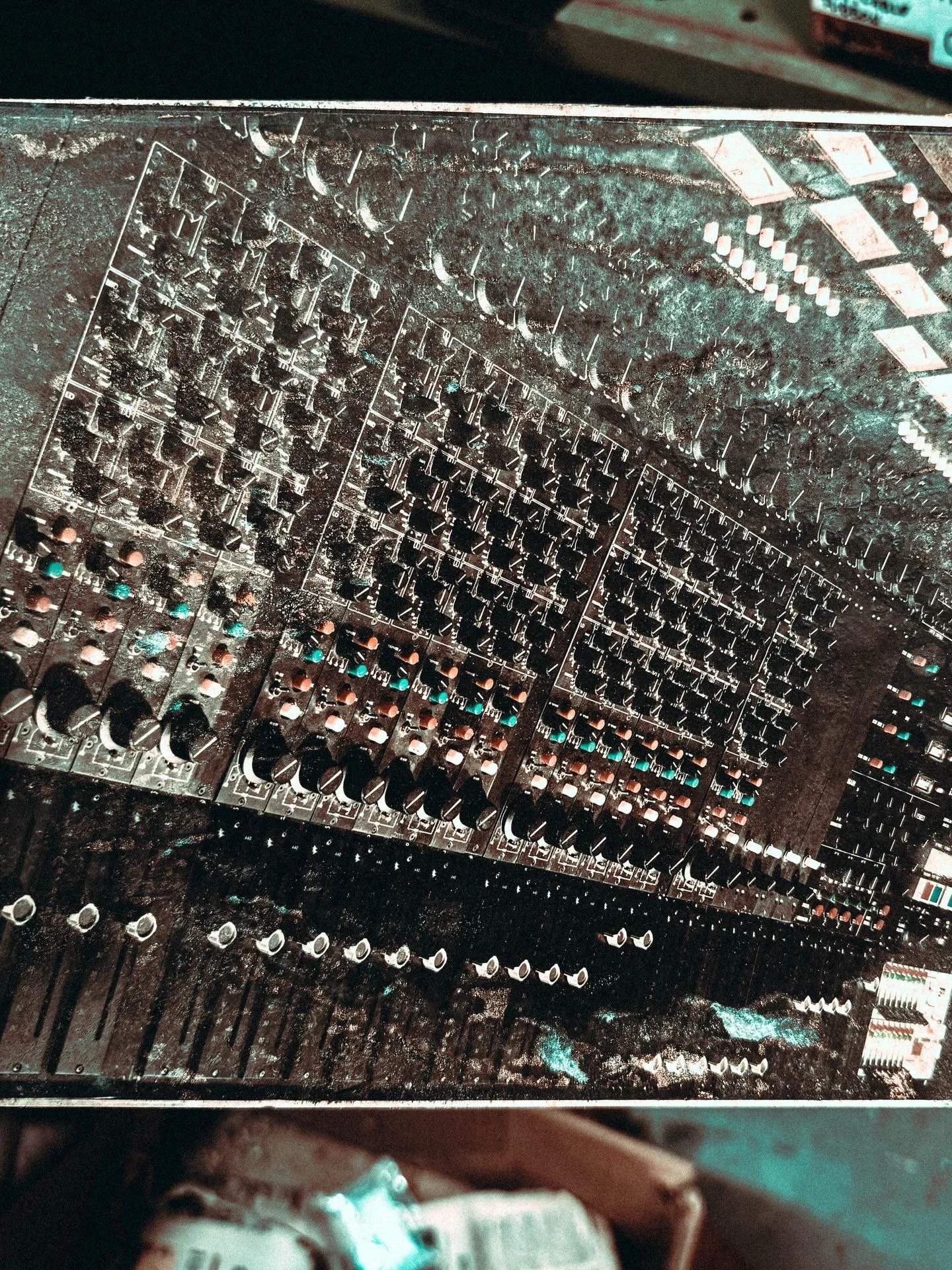
I opened the top panel, photographed everything, and posted the images on Instagram. Joe Malone at JLM Audio reached out almost immediately. Joe recognized from the photos that the op-amps and filter blocks were unpotted, no black epoxy. The modules inside a production ITI EQ are black-box potted epoxy assemblies that cannot be opened, examined, or replicated. These could be.
Joe rebuilt all the op-amps so that others could take advantage of what was inside, replaced the original power supply with a modern compact SMPS unit with improved filtering, and restored the module to full working order. The units in my mastering room today are the same ones Burgess Macneal and George Massenburg worked on in Hunt Valley in 1969. Tomecek, when told it was still running daily sessions, said he wasn't surprised: "they used nothing but quality stuff." It's been running sessions for over fifty years.
Still Running
The history of the parametric EQ runs from a Baltimore high school through a Hunt Valley console shop, a knife in an office door, an AES convention, a Baltimore harbor, a Craigslist listing, and a shipping box to Australia and back. The unit in my rack today carries all of that with it. Every session it touches, it still does exactly what Massenburg set out to make it do in 1969: three parameters, continuously variable, no compromises.
Serial numbers 001 and 002 are in my mastering room in Baltimore, a few miles from where they were built, and a short swim from where the Blue Seas barge came to rest. Tomecek's first reaction when told the unit was still running daily was "I'm surprised it's still running." He caught himself immediately: "I shouldn't say that. They used nothing but quality stuff." That wasn't modesty. ITI paid top price for the best components each manufacturer made. In an era when cheap electrolytic capacitors were quietly killing gear across the industry, I'm still reaping the benefit of that decision every day. It cost $100 on Craigslist. Adjusted for what it is, that might be the best deal in Baltimore audio history.
For anyone running ITI units in the wild: Macneal confirmed in 2023 that Sontec continues to keep replacement amplifiers in stock. A particular transistor in the original units was prone to failure, and knowing this, Sontec has maintained a supply of both amplifier variants. Joe Malone at JLM Audio in Australia is another reliable source, and given that Sontec can be difficult to reach, JLM may be the more practical first call. JLM stocks SMD replacement op-amps for the ITI 30329 and filter module replacements for the ITI 30229, as well as adaptor boards that allow modern discrete op-amps to drop into the original module footprint. All of it ships internationally. Details at jlmaudio.com.






Sources and Notes
Primary Sources
Burgess Macneal, phone interview with the author, February 2023. All direct quotations from Macneal and all details new to the published record derive from this conversation unless otherwise noted. This includes the Bose console module order, the DJW serial number, the sinking account, the Sheffield unit count, and Carolyn Macneal's identification of the resistor orientation.
Burgess Macneal, interviewed by Adam Sherwood, AudioTechnology magazine, issue 60. The primary published account of the ITI and Sontec history.
George Massenburg, "Parametric Equalization," 42nd AES Convention, Los Angeles, 1972. Available at massenburg.com.
ITI Audio MEP-130 Parametric Equalizer Channel Module Technical Manual. Original production document. Linked above.
Original factory test reports, Serial Numbers 001 and 002, September 21, 1976. In the author's possession.
ITI Audio Products MEP-130 marketing sheet. Original production document. In the author's possession.
dB Magazine, May 1973. Review and advertisement for the MEP-130.
Joe Malone, JLM Audio. Correspondence with the author, 2017 onward. Source for restoration details and parts availability.
Doug Tomecek, phone interview with the author, May 2026. Tomecek recorded approximately four albums at ITI's Recordings Incorporated facility in Cockeysville and was a close personal friend of Donald J. Wilke for approximately fifty years. He received the demonstration prototype directly from Wilke between 1978 and 1980. All details attributable to Tomecek in this article derive from this conversation.
Original Craigslist listing for the ITI MEP-130 units, in the author's possession. The listing is a secondary source reflecting the seller's recollections and is evaluated critically where it appears in the article.
Notes
The $670.00 price converts to roughly $4,900 in 2026 dollars using the U.S. Bureau of Labor Statistics CPI calculator. Magic.
The Walt Jung account derives from Massenburg's published writings. Jung later wrote the IC OpAmp Cookbook (Howard W. Sams, 1974).
The Dolby prior art claim is referenced in Massenburg's published accounts. The author has not independently verified the outcome.
Carolyn Macneal's role as production lead is confirmed in both the AT Magazine interview and the 2023 phone conversation.
Massenburg's published writings name four engineers as possible claimants to the modern parametric EQ concept: Bob Meushaw, Burgess Macneal, Daniel Flickinger, and Massenburg himself. Flickinger developed his own parametric designs independently and had largely left the audio industry by the early 1970s. The question of priority has never been formally adjudicated.